Skip to main content
Nutrition
My Course
Learn
Exam Prep
AI Tutor
Study Guides
Flashcards
Try the app
My Course
Learn
Exam Prep
AI Tutor
Study Guides
Flashcards
Try the app
Back
Nutrition For Young Children (Ages 1-5) quiz
You can tap to flip the card.
What is the recommended daily caloric intake range for children ages 1-5?
You can tap to flip the card.
👆
What is the recommended daily caloric intake range for children ages 1-5?
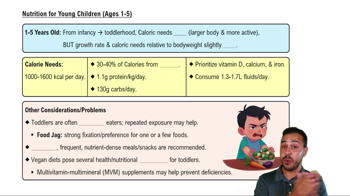
Children ages 1-5 should consume between 1,000 and 1,600 kilocalories per day, depending on factors like physical activity.
Track progress
Control buttons has been changed to "navigation" mode.
1/15
Related flashcards
Related practice
Recommended videos
Nutrition For Young Children (Ages 1-5) definitions
Nutrition For Young Children (Ages 1-5)
15 Terms
Nutrition For Young Children (Ages 1-5)
15. Nutrition: Toddlers to Late Adulthood
10 problems
Topic
Nutrition For School-Age Children (Ages 6-11)
15. Nutrition: Toddlers to Late Adulthood
10 problems
Topic
15. Nutrition: Toddlers to Late Adulthood
4 topics
15 problems
Chapter
Guided course
01:50
Nutrition For Young Children (Ages 1-5) Example 1
03:26
Nutrition For Young Children (Ages 1-5)
Terms in this set (15)
Hide definitions
What is the recommended daily caloric intake range for children ages 1-5?
Children ages 1-5 should consume between 1,000 and 1,600 kilocalories per day, depending on factors like physical activity.
What percentage of daily calories should come from fat for young children?
30–40% of daily calories should come from fat for children ages 1-5.
Why is whole milk recommended over low-fat milk for young children?
Whole milk is recommended because young children need a higher percentage of calories from fat to support growth and development.
What is the protein requirement for children ages 1-5?
Children in this age group need 1.1 grams of protein per kilogram of body weight per day.
How many grams of carbohydrates should children ages 1-5 consume daily?
They should consume 130 grams of carbohydrates per day.
Which three micronutrients are of particular concern for young children?
Vitamin D, calcium, and iron are key micronutrients to prioritize for children ages 1-5.
What is the recommended daily fluid intake for children ages 1-5?
Children in this age group should consume between 1.3 and 1.7 liters of fluids daily.
What is a common eating behavior in toddlers that involves rejecting certain foods?
Toddlers often exhibit picky eating, where they reject and exclude various healthy foods.
How can parents help reduce picky eating in young children?
Repeated exposure to healthy foods, 8–15 times, can help reduce picky eating.
What are food jags and how long do they typically last?
Food jags are strong fixations on one or a few foods, usually lasting a few days or weeks.
When should parents seek professional help regarding food jags?
If a food jag lasts longer than a few weeks, parents should consult a healthcare professional.
How should meals and snacks be structured for young children?
Children ages 1-5 should have small, frequent, nutrient-dense meals and snacks rather than three large meals.
What are the risks of a vegan diet for young children?
Vegan diets can pose health and nutritional risks for toddlers if not carefully planned.
What is commonly recommended to prevent deficiencies in children on vegan diets?
Multivitamin-mineral (MVM) supplements are often recommended to help prevent deficiencies.
Why do caloric needs per kilogram decrease as children transition from infancy to toddlerhood?
Caloric needs per kilogram decrease because the growth rate slows down after infancy, even though overall caloric needs increase.
 BackBack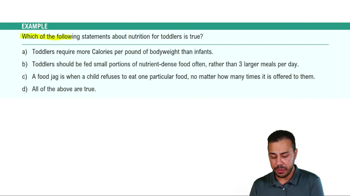
 01:50
01:50