Skip to main content
Nutrition
My Course
Learn
Exam Prep
AI Tutor
Study Guides
Flashcards
Try the app
My Course
Learn
Exam Prep
AI Tutor
Study Guides
Flashcards
Try the app
Back
Nutrition For Young Children (Ages 1-5) definitions
You can tap to flip the card.
Caloric Needs
You can tap to flip the card.
👆
Caloric Needs
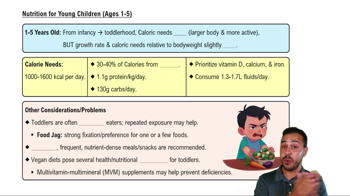
Daily energy requirements that increase with age and activity, typically ranging from 1,000 to 1,600 kilocalories for young children.
Track progress
Control buttons has been changed to "navigation" mode.
1/15
Related flashcards
Related practice
Recommended videos
Nutrition For Young Children (Ages 1-5) quiz
Nutrition For Young Children (Ages 1-5)
15 Terms
Nutrition For Young Children (Ages 1-5)
15. Nutrition: Toddlers to Late Adulthood
10 problems
Topic
Nutrition For School-Age Children (Ages 6-11)
15. Nutrition: Toddlers to Late Adulthood
10 problems
Topic
15. Nutrition: Toddlers to Late Adulthood
4 topics
15 problems
Chapter
Guided course
01:50
Nutrition For Young Children (Ages 1-5) Example 1
03:26
Nutrition For Young Children (Ages 1-5)
Terms in this set (15)
Hide definitions
Caloric Needs
Daily energy requirements that increase with age and activity, typically ranging from 1,000 to 1,600 kilocalories for young children.
Whole Milk
A dairy product recommended for young children due to its higher fat content, supporting growth and brain development.
Protein Requirement
The amount of protein needed per kilogram of body weight, higher in young children than adults to support growth.
Carbohydrate Intake
A consistent daily amount of 130 grams, necessary for energy and brain function in children over one year old.
Vitamin D
A micronutrient essential for bone health and calcium absorption, often prioritized in early childhood diets.
Calcium
A mineral crucial for bone development and strength, especially important during rapid growth phases in young children.
Iron
A micronutrient vital for cognitive development and preventing anemia, commonly monitored in young children.
Hydration
Adequate fluid intake, typically 1.3 to 1.7 liters daily, necessary for healthy growth and physiological functions.
Picky Eating
A common behavior in toddlers involving rejection of certain foods, potentially impacting nutrient intake.
Food Jags
Temporary periods when a child insists on eating only a few specific foods, possibly leading to nutrient gaps if prolonged.
Nutrient-Dense Meals
Small, frequent servings rich in essential nutrients, recommended to meet the dietary needs of young children.
Vegan Diet
A plant-based eating pattern requiring careful planning in young children to prevent nutritional deficiencies.
Multivitamin-Mineral Supplement
A product often recommended to fill potential nutrient gaps in young children's diets, especially with dietary restrictions.
Growth Rate
The speed of physical development, which slows after infancy but still requires increased nutrient intake in early childhood.
Nutritional Deficiency
A lack of essential nutrients that can result from prolonged poor dietary habits or restrictive eating patterns in children.
 BackBack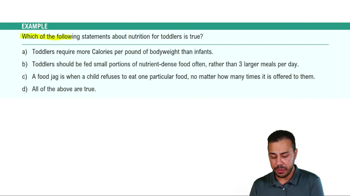
 01:50
01:50