No, a calorie is a unit of energy, not a type of nutrient like carbohydrate.
What is the definition of an empty calorie?
An empty calorie refers to energy provided by food that contains little or no nutritional value beyond calories, such as added sugars or solid fats.
What is the difference between a calorie with a lowercase 'c' and a Calorie with an uppercase 'C'?
A lowercase 'c' calorie is the energy needed to heat 1 gram of water by 1°C, while an uppercase 'C' Calorie (kilocalorie) equals 1,000 lowercase 'c' calories and is the unit used in nutrition.
Which macronutrient contains the most calories per gram?
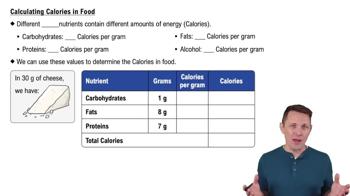
Fat contains the most calories per gram, providing 9 calories per gram.
What is the difference between calories and kilocalories in nutrition?
In nutrition, the term 'calorie' typically refers to a kilocalorie (kcal), which is equal to 1,000 small 'c' calories.
How are calories or kilocalories used to measure energy in food?
Calories or kilocalories measure the amount of energy provided by food, specifically from macronutrients like carbohydrates, proteins, and fats.
How do you convert calories to joules?
To convert calories to joules, multiply the number of calories by 4.184 (1 calorie = 4.184 joules).
Which macronutrient provides the most calories per gram?
Fat provides the most calories per gram, with 9 calories per gram.
How many calories per gram are in vitamins?
Vitamins do not provide calories per gram; they do not supply energy.
How do you convert calories to kilojoules?
To convert calories to kilojoules, multiply the number of calories by 4.184 (1 calorie = 4.184 kilojoules).
How many calories are in 1 gram of carbohydrates?
There are 4 calories in 1 gram of carbohydrates.
How many calories does 25 grams of fat provide?
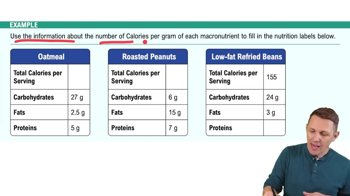
25 grams of fat provide 225 calories (25 grams × 9 calories/gram = 225 calories).
How many calories are in a gram of fat?
There are 9 calories in a gram of fat.
Do vitamins provide calories per gram?
No, vitamins do not provide calories per gram.
How many calories are in 1 gram of carbohydrates?
There are 4 calories in 1 gram of carbohydrates.
How do you convert calories to kilojoules?
Multiply the number of calories by 4.184 to get kilojoules.
How many calories are in one gram of fat?
There are 9 calories in one gram of fat.
How do you convert calories to joules?
Multiply the number of calories by 4.184 to get joules.
How many calories are in a gram of carbohydrates?
There are 4 calories in a gram of carbohydrates.
How many calories are in 30 grams of fat?
30 grams of fat provide 270 calories (30 grams × 9 calories/gram = 270 calories).
How many calories are in one gram of fat?
There are 9 calories in one gram of fat.
How many calories are in a gram of fat?
There are 9 calories in a gram of fat.
How do you convert kilojoules to calories?
Divide the number of kilojoules by 4.184 to get calories.
How many calories are in a gram of carbohydrates?
There are 4 calories in a gram of carbohydrates.
How many calories are in one gram of carbohydrates?
There are 4 calories in one gram of carbohydrates.
How many calories are in 1 gram of fat?
There are 9 calories in 1 gram of fat.
How many calories per gram does fat provide?
Fat provides 9 calories per gram.
Do gum calories count if you don't swallow it?
If you do not swallow gum, most of its calories are not absorbed, so they generally do not count.
If you don't swallow gum, do the calories count?
No, if you don't swallow gum, the calories are not absorbed and do not count.
Which substances contain no calories?
Water, vitamins, and minerals contain no calories.
 Back
Back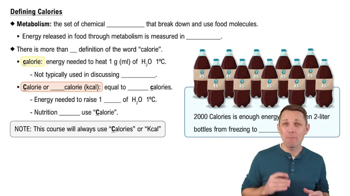
 04:10
04:10