Skip to main content
Nutrition
My Course
Learn
Exam Prep
AI Tutor
Study Guides
Flashcards
Try the app
My Course
Learn
Exam Prep
AI Tutor
Study Guides
Flashcards
Try the app
Back
Energy in Food quiz
You can tap to flip the card.
What is metabolism in the context of nutrition?
You can tap to flip the card.
👆
What is metabolism in the context of nutrition?
Metabolism is the set of chemical reactions that break down and use food molecules to release energy in the cells.
Track progress
Control buttons has been changed to "navigation" mode.
1/15
Related flashcards
Related practice
Recommended videos
Energy in Food definitions
Energy in Food
15 Terms
Energy in Food exam
Energy in Food
29 Terms
Energy in Food quiz #1
Energy in Food
30 Terms
Energy in Food
1. Science of Nutrition
10 problems
Topic
Nutrition as a Science
1. Science of Nutrition
10 problems
Topic
1. Science of Nutrition
8 topics
15 problems
Chapter
04:10
Defining Calories
04:06
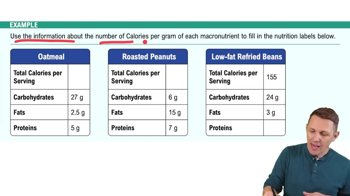
Energy in Food Example 1
03:18
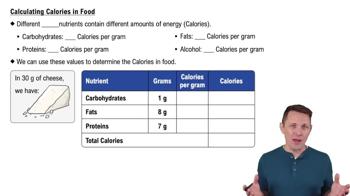
Calculating Calories in Food
Terms in this set (15)
Hide definitions
What is metabolism in the context of nutrition?
Metabolism is the set of chemical reactions that break down and use food molecules to release energy in the cells.
What unit is used to measure the energy in food?
The energy in food is measured in calories.
What is the technical definition of a lowercase 'c' calorie?
A lowercase 'c' calorie is the energy needed to heat one gram of water by one degree Celsius.
Why is the lowercase 'c' calorie not typically used in nutrition?
Because it represents a very small amount of energy, which is not practical for measuring the energy in food.
What is an uppercase 'C' Calorie (kilocalorie or kcal)?
An uppercase 'C' Calorie, kilocalorie, or kcal is equal to 1,000 lowercase 'c' calories.
How much energy does one kilocalorie provide in terms of heating water?
One kilocalorie is the energy needed to raise one liter of water by one degree Celsius.
Which unit do nutrition labels use to report calories?
Nutrition labels use the uppercase 'C' Calorie or kilocalorie, even if written as a lowercase 'c'.
How many calories per gram do carbohydrates provide?
Carbohydrates provide 4 calories per gram.
How many calories per gram do proteins provide?
Proteins provide 4 calories per gram.
How many calories per gram do fats provide?
Fats provide 9 calories per gram.
How many calories per gram does alcohol provide?
Alcohol provides 7 calories per gram, though it is not a macronutrient.
How do you calculate the total calories in a food item from its macronutrient content?
Multiply the grams of each macronutrient by its respective calories per gram, then sum the results.
Why might the total grams of macronutrients not equal the total weight of a food item?
Because foods contain other components like water, which add weight but do not provide calories.
Why do fats provide more energy per gram than carbohydrates or proteins?
Fats provide more than twice as much energy per gram because they are more energy-dense.
If a serving of food contains 1g carbohydrate, 8g fat, and 7g protein, how many total calories does it provide?
It provides 4 (carbs) + 72 (fat) + 28 (protein) = 104 total calories.
 BackBack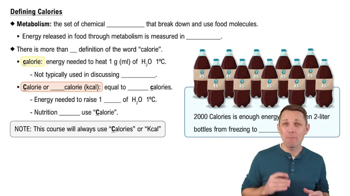
 04:10
04:10