Inflation is a general increase in the price level of goods and services in an economy.
Who are fixed income receivers and how does unanticipated inflation affect them?
Fixed income receivers are people whose income does not change with inflation, such as retirees with pensions; unanticipated inflation reduces their real income and purchasing power.
Why do savers lose out during unanticipated inflation?
Savers lose out because the real value of their savings decreases as prices rise, especially if their savings earn little or no interest.
How does inflation affect creditors?
Creditors are hurt by unanticipated inflation because the money they are repaid has less purchasing power than when it was originally loaned.
What is the difference between nominal income and real income?
Nominal income is the amount of money received in current dollars, while real income adjusts for changes in price level, reflecting actual purchasing power.
How does inflation impact someone who hoards cash?
Someone who hoards cash loses purchasing power because the cash does not earn interest and its value decreases as prices rise.
What is a cost of living adjustment (COLA) and who benefits from it?
A cost of living adjustment is an increase in income to match inflation, benefiting flexible income receivers like those with union contracts or Social Security.
How are debtors affected by unanticipated inflation?
Debtors benefit from unanticipated inflation because they repay loans with money that is worth less than when they borrowed it.
Why might landlords with fixed lease payments be hurt by inflation?
Landlords with fixed lease payments are hurt because their rental income stays the same while the cost of goods and services rises, reducing their real income.
What happens to the real interest rate when inflation is higher than expected?
The real interest rate falls, meaning savers and creditors earn less in terms of purchasing power.
How does anticipated inflation differ from unanticipated inflation?
Anticipated inflation is expected and can be planned for, while unanticipated inflation is unexpected and can cause economic losses for some groups.
What is the effect of inflation on market equilibrium?
Unanticipated inflation can disrupt market equilibrium by altering real incomes and costs, affecting supply and demand.
How does inflation relate to opportunity cost?
Inflation increases the opportunity cost of holding cash or low-interest assets, as their real value declines over time.
Why is understanding inflation important for economic agents?
Understanding inflation helps economic agents anticipate changes in purchasing power and make informed financial decisions.
What is the main risk for creditors during periods of high unanticipated inflation?
The main risk is that the money repaid to them will have significantly less purchasing power than when it was lent out.
 Back
Back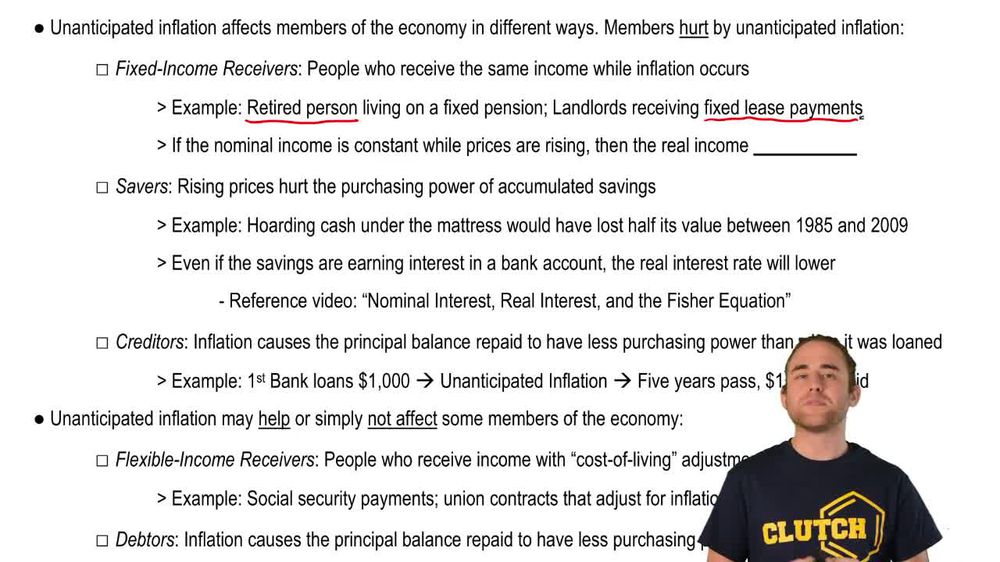
 05:58
05:58