Skip to main content
Microeconomics
My Course
Learn
Exam Prep
AI Tutor
Study Guides
Flashcards
Explore
Try the app
My Course
Learn
Exam Prep
AI Tutor
Study Guides
Flashcards
Explore
Try the app
Back
The Saving Function definitions
You can tap to flip the card.
Savings Function
You can tap to flip the card.
👆
Savings Function
Shows the relationship between household savings and disposable income, illustrating how savings change as income changes.
Track progress
Control buttons has been changed to "navigation" mode.
1/15
Related flashcards
Recommended videos
The Saving Function quiz
The Saving Function
15 Terms
Guided course
06:14
Saving Function (Saving Schedule)
1
views
Terms in this set (15)
Hide definitions
Savings Function
Shows the relationship between household savings and disposable income, illustrating how savings change as income changes.
Disposable Income
Represents income available to households after taxes, which can be allocated to either consumption or savings.
Consumption Function
Describes how household consumption varies with disposable income, paralleling the savings function in structure.
Savings Schedule
A tabular or graphical representation of savings at various levels of disposable income.
Consumption Schedule
A table or graph showing consumption amounts at different disposable income levels.
Marginal Propensity to Save
Measures the fraction of each additional dollar of disposable income that is saved, represented by the slope of the savings function.
Marginal Propensity to Consume
Indicates the portion of extra disposable income spent on consumption, typically larger than the marginal propensity to save.
Slope
Reflects the rate at which savings or consumption changes in response to changes in disposable income.
45 Degree Line
A reference line on a graph where all disposable income is either saved or consumed, depending on the function being analyzed.
Change in Savings
Represents the difference in savings resulting from a change in disposable income.
Change in Disposable Income
The increase or decrease in income available to households after taxes, affecting both savings and consumption.
Household Savings
The portion of disposable income not spent on consumption, accumulated for future use.
Bonus
An extra payment received by households, often leading to increased savings and consumption.
Annual Raise
A yearly increase in salary, contributing to higher disposable income and affecting savings behavior.
Allocation
The process of dividing disposable income between consumption and savings.
 BackBack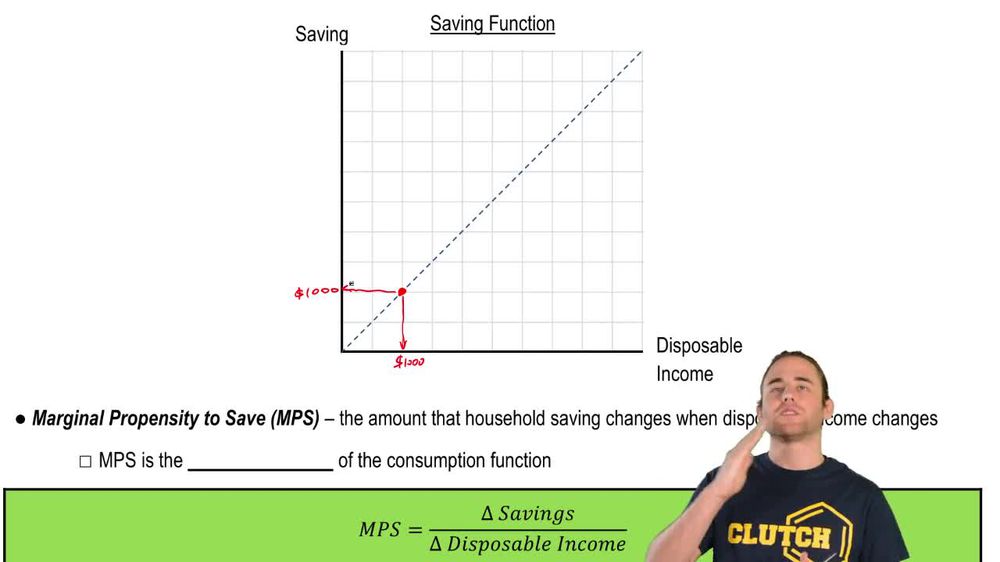
 06:14
06:14