What was the primary cause of the 2007-2009 financial crisis?
The crisis was mainly caused by risky subprime mortgage loans and a crash in the real estate market, leading to widespread loan defaults.
What are subprime mortgage loans?
Subprime mortgage loans are high-interest loans given to risky borrowers who are more likely to default, often with little or no down payment required.
What is a mortgage-backed security (MBS)?
A mortgage-backed security is a financial asset created by bundling together various home loans and selling shares of the bundle to investors.
How did investment banks contribute to the financial crisis?
Investment banks heavily invested in mortgage-backed securities, which became worthless when homeowners defaulted on their loans.
What is the difference between commercial banks and investment banks?
Commercial banks accept deposits and are FDIC insured, while investment banks trade financial assets and are not insured.
Why did mortgage-backed securities initially seem profitable?
They seemed profitable because homeowners, including risky borrowers, were making their payments during the booming real estate market.
What happened when housing prices fell during the crisis?
Homeowners owed more on their mortgages than their homes were worth, leading many to default and walk away from their loans.
What was the Troubled Asset Relief Program (TARP)?
TARP was a government bailout where the government bought toxic mortgage-backed securities from investment banks to prevent systemic collapse.
Why were some banks considered 'too big to fail'?
They were considered too big to fail because their collapse could have triggered a domino effect, threatening the entire financial system.
What is moral hazard in the context of the financial crisis?
Moral hazard refers to banks taking excessive risks, believing the government will bail them out if their investments fail.
How did the shadow banking system affect the crisis?
The shadow banking system loosened credit and enabled unregulated financial activities, contributing to the proliferation of risky loans.
What role did government regulation play in the crisis?
Lack of regulation allowed banks to make risky loans and investments, which ultimately led to market failure and the crisis.
What is market failure, as illustrated by the crisis?
Market failure occurred when unregulated financial markets led to inefficient outcomes and economic instability.
How did the government’s intervention aim to prevent a depression?
The government intervened to prevent a domino effect of bank failures that could have led to a depression similar to the 1930s.
Why did the bailout create controversy regarding incentives?
The bailout was controversial because it encouraged banks to take risks, knowing they might be rescued, undermining incentives for prudent behavior.
 Back
Back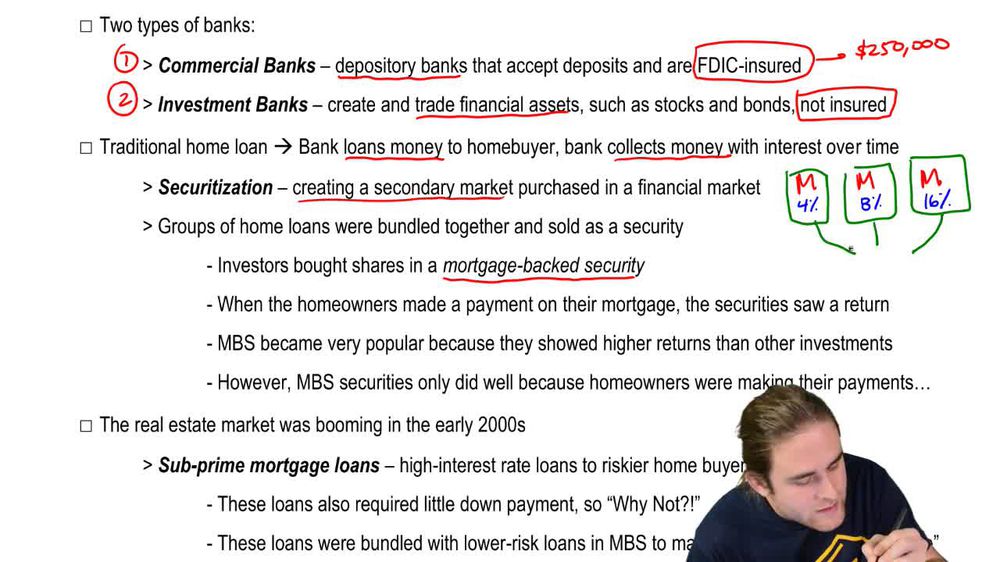
 10:32
10:32