Back

Using the Supply and Demand Curves to Find Equilibrium quiz

Control buttons has been changed to "navigation" mode.
1/15
  • What is market equilibrium in terms of quantity demanded and quantity supplied?

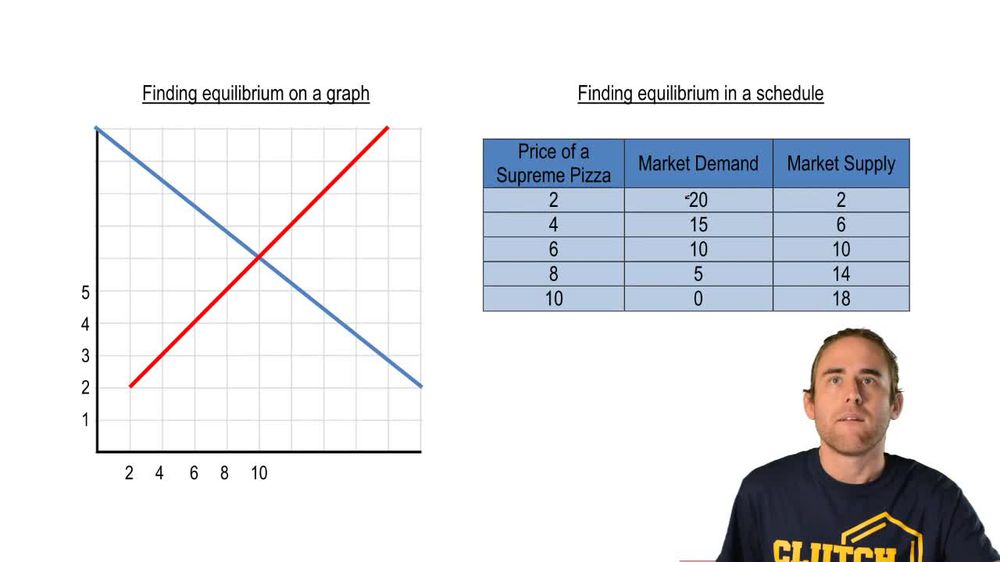
    Market equilibrium occurs when quantity demanded equals quantity supplied.
  • How do you identify the equilibrium price and quantity on a supply and demand graph?

    The equilibrium price and quantity are found at the intersection point of the supply and demand curves.
  • What notation is commonly used for equilibrium price and equilibrium quantity?

    Equilibrium price is denoted as P* (P star) and equilibrium quantity as Q* (Q star).
  • What happens in the market if the price is set above the equilibrium price?

    If the price is above equilibrium, there is excess supply (a surplus), leading suppliers to lower prices.
  • What does the law of supply and demand state about price adjustments?

    The law of supply and demand states that prices will adjust until the market reaches equilibrium.
  • How can equilibrium be found using a schedule (table) of prices and quantities?

    Equilibrium is found where the quantity supplied equals the quantity demanded at a specific price in the schedule.
  • What is the effect on equilibrium price and quantity when demand shifts to the right?

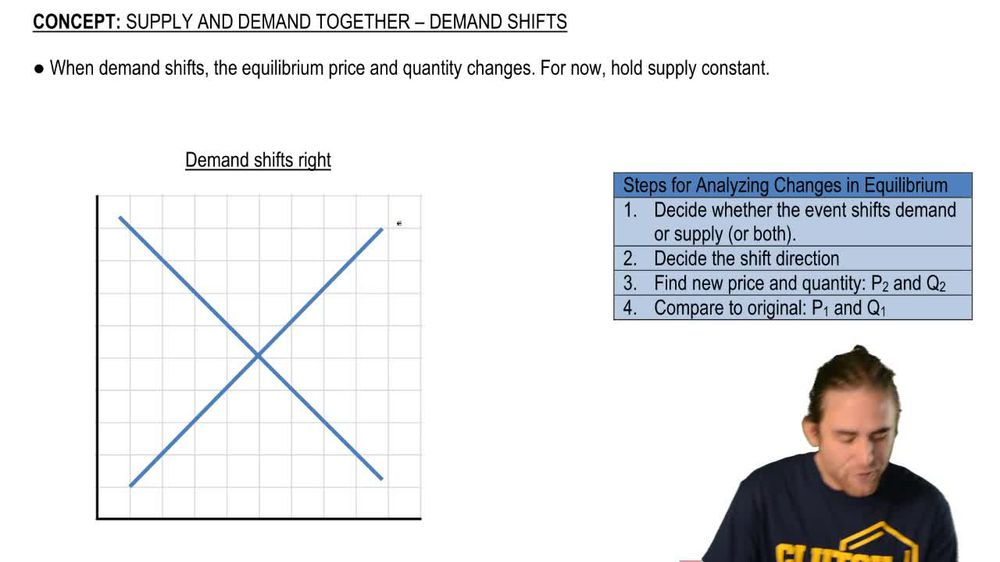
    When demand shifts to the right, equilibrium price and equilibrium quantity both increase.
  • What happens to equilibrium price and quantity when demand shifts to the left?

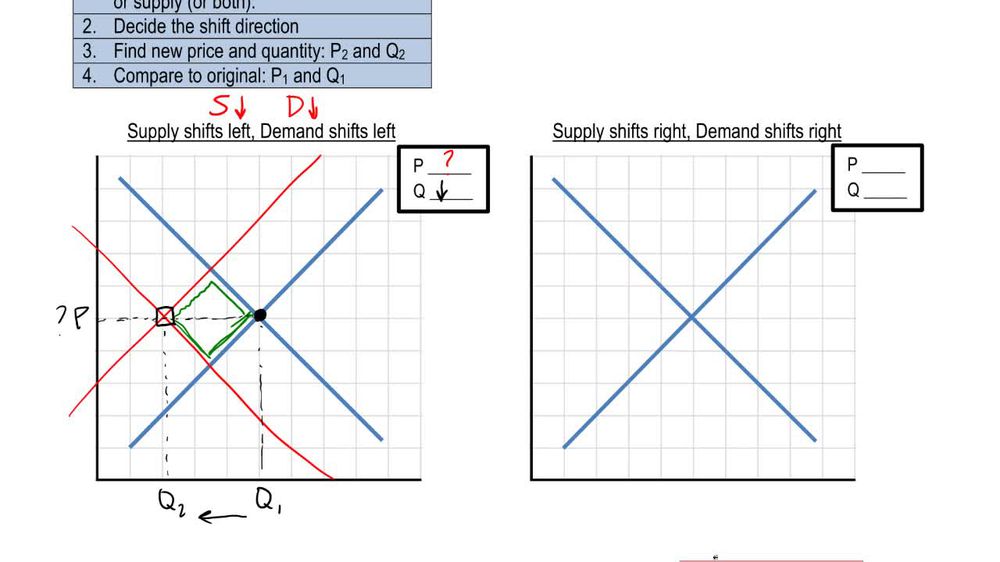
    When demand shifts to the left, both equilibrium price and equilibrium quantity decrease.
  • If supply shifts to the right, what is the effect on equilibrium price and quantity?

    A rightward shift in supply decreases equilibrium price and increases equilibrium quantity.
  • What is the result of a leftward shift in the supply curve on equilibrium?

    A leftward shift in supply increases equilibrium price and decreases equilibrium quantity.
  • When both supply and demand shift, why is one variable considered ambiguous?

    One variable (either price or quantity) is ambiguous because the direction of its change depends on the relative size of the shifts.
  • If both supply and demand shift to the right equally, what happens to equilibrium price and quantity?

    Quantity definitely increases, but the change in price is ambiguous.
  • When supply shifts left and demand shifts right, which variable is ambiguous and which is certain?

    Quantity is ambiguous, but price definitely increases.
  • What is the recommended method for analyzing double shifts in supply and demand?

    Draw both curves shifted by equal amounts to easily identify which variable is ambiguous.
  • Why is using a graph helpful when analyzing shifts in supply and demand?

    Using a graph provides a clear visual understanding of how equilibrium price and quantity change with shifts.