Skip to main content
Microeconomics
My Course
Learn
Exam Prep
AI Tutor
Study Guides
Flashcards
Explore
Try the app
My Course
Learn
Exam Prep
AI Tutor
Study Guides
Flashcards
Explore
Try the app
Back
Short Run Aggregate Supply quiz
You can tap to flip the card.
What does the short-run aggregate supply (SRAS) curve look like compared to the long-run aggregate supply curve?
You can tap to flip the card.
👆
What does the short-run aggregate supply (SRAS) curve look like compared to the long-run aggregate supply curve?
The SRAS curve slopes upward, unlike the vertical long-run aggregate supply curve.
Track progress
Control buttons has been changed to "navigation" mode.
1/15
Related flashcards
Recommended videos
Short Run Aggregate Supply definitions
Short Run Aggregate Supply
13 Terms
Guided course
04:16
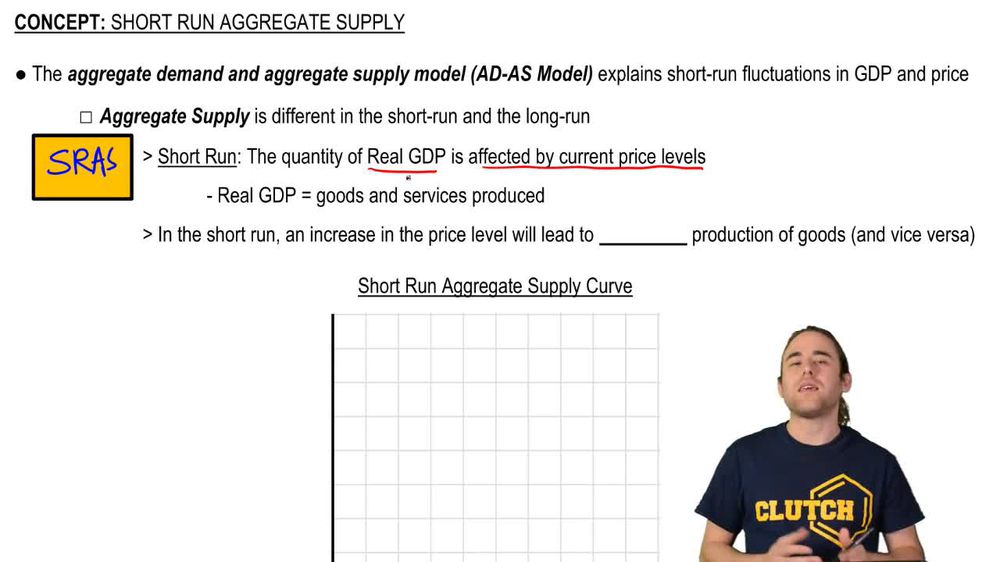
Short Run Aggregate Supply Slopes Upwards
Guided course
02:52
Short Run Aggregate Supply
Terms in this set (15)
Hide definitions
What does the short-run aggregate supply (SRAS) curve look like compared to the long-run aggregate supply curve?
The SRAS curve slopes upward, unlike the vertical long-run aggregate supply curve.
What happens to real GDP production when the price level increases in the short run?
Real GDP production increases as the price level rises in the short run.
What is meant by 'sticky wages' in the context of SRAS?
Sticky wages refer to wages that do not increase as quickly as the price level, remaining relatively fixed in the short run.
How do sticky wages affect firms' profits when price levels rise?
Sticky wages cause firms' profits to increase because their costs stay stable while selling prices rise.
Why might union wages contribute to wage stickiness?
Union wages are often set by contracts and remain fixed for several years, making them slow to adjust to changing price levels.
What is the sticky price theory?
Sticky price theory suggests that some prices do not rise as quickly as the overall price level due to menu costs.
What are menu costs and how do they relate to sticky prices?
Menu costs are expenses businesses face when changing prices, such as printing new menus, which can discourage frequent price changes.
How does sticky price theory lead to increased output for some firms?
Firms with sticky prices attract more customers when overall prices rise, leading them to increase their output.
What is the misperceptions theory in the context of SRAS?
Misperceptions theory states that firms may mistakenly interpret rising price levels as a signal to increase production.
How do the sticky wage and sticky price theories both explain the upward slope of the SRAS curve?
Both theories show that as price levels rise, firms are incentivized to supply more due to increased profits or higher demand.
What happens to real GDP when the price level decreases in the short run?
Real GDP decreases as the price level falls in the short run.
In the SRAS model, what does the price level axis represent?
The price level axis represents the overall prices of goods and services in the economy.
What does the real GDP axis represent in the SRAS model?
The real GDP axis shows the quantity of goods and services produced in the economy.
Why is the SRAS curve not vertical like the long-run aggregate supply curve?
The SRAS curve is not vertical because real GDP production responds to changes in price levels in the short run.
How do misperceptions about price changes affect aggregate supply in the short run?
Misperceptions lead firms to produce more when they see higher prices, even if those prices reflect general inflation rather than increased demand.
 BackBack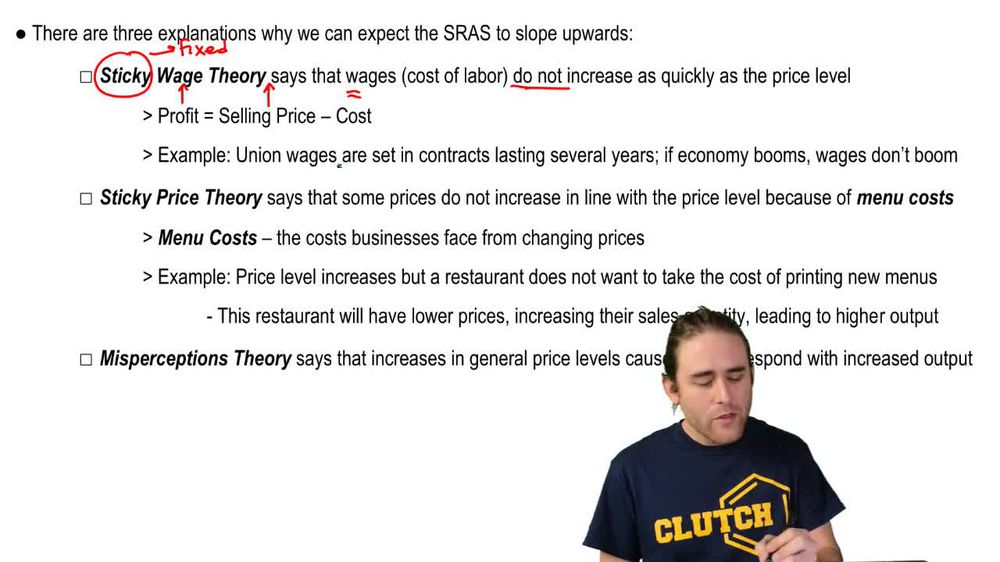
 04:16
04:16