Skip to main content
Microeconomics
My Course
Learn
Exam Prep
AI Tutor
Study Guides
Flashcards
Explore
Try the app
My Course
Learn
Exam Prep
AI Tutor
Study Guides
Flashcards
Explore
Try the app
Back
Short Run Aggregate Supply definitions
You can tap to flip the card.
Short Run Aggregate Supply
You can tap to flip the card.
👆
Short Run Aggregate Supply
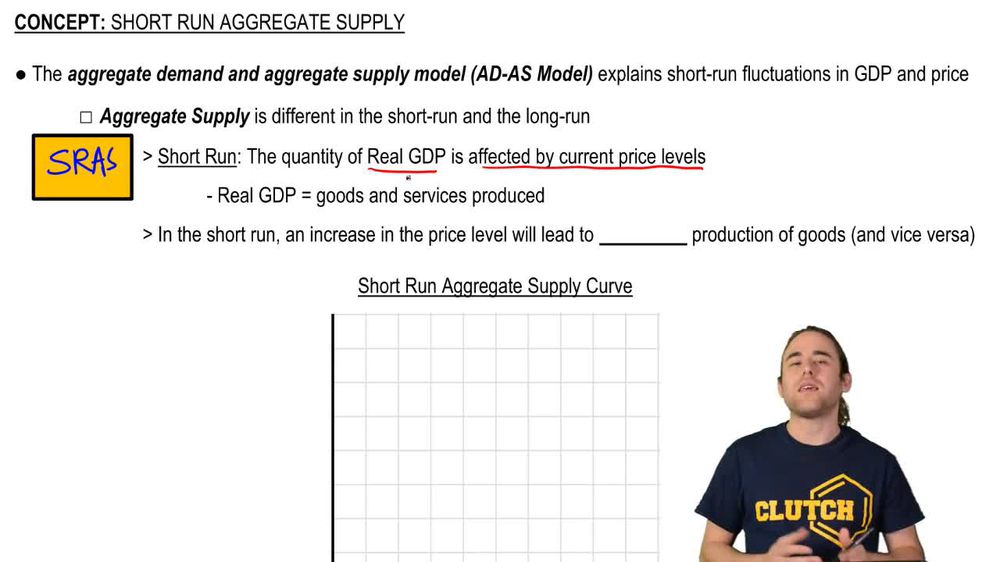
An upward-sloping curve showing the relationship between price levels and real GDP produced in the economy over a limited period.
Track progress
Control buttons has been changed to "navigation" mode.
1/13
Related flashcards
Recommended videos
Short Run Aggregate Supply quiz
Short Run Aggregate Supply
15 Terms
Guided course
04:16
Short Run Aggregate Supply Slopes Upwards
Guided course
02:52
Short Run Aggregate Supply
Terms in this set (13)
Hide definitions
Short Run Aggregate Supply
An upward-sloping curve showing the relationship between price levels and real GDP produced in the economy over a limited period.
ADAS Model
A framework combining aggregate demand and aggregate supply to analyze overall economic output and price levels.
Real GDP
The total value of goods and services produced, adjusted for inflation, reflecting actual output rather than price changes.
Price Level
A measure representing the average prices of all goods and services within an economy at a given time.
Sticky Wage Theory
A concept where wages remain fixed as prices rise, increasing profits and encouraging higher production.
Sticky Price Theory
A concept where some prices remain unchanged due to costs of adjustment, resulting in increased sales and output.
Menu Costs
Expenses businesses face when changing prices, such as printing new menus, which can discourage frequent price adjustments.
Union Wages
Salaries set by labor contracts, typically fixed for several years, contributing to wage rigidity during economic changes.
Profit
The financial gain realized when selling prices rise while production costs, like wages, remain stable.
Misperceptions Theory
A concept where firms mistakenly interpret rising prices as increased demand, prompting higher output.
Market Equilibrium
A state where aggregate supply and aggregate demand intersect, determining the economy's output and price level.
Price Elasticity of Supply
A measure of how responsive the quantity supplied is to changes in price levels within the economy.
Factors of Production
Resources such as labor and capital that determine the economy's capacity to produce goods and services.
 BackBack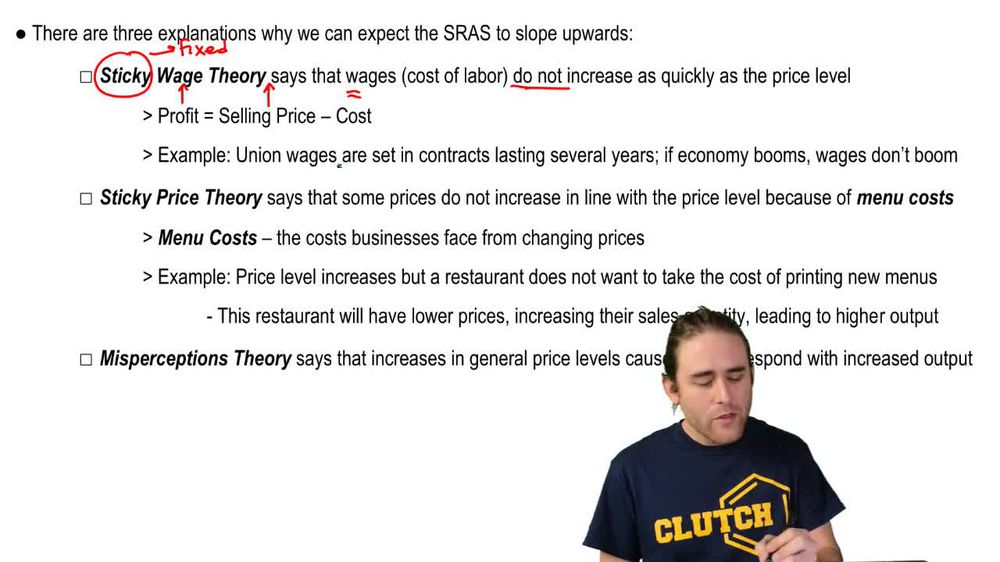
 04:16
04:16