What is the key identity relating savings and investment in a closed economy?
In a closed economy, national savings equals investment (S = I).
How is savings defined in the context of macroeconomics?
Savings is the portion of current income not consumed by households or spent by the government.
What is the difference between economic investment and financial investment in economics?
Economic investment refers to firms purchasing capital goods to increase future output, while financial investment involves households buying assets like stocks and bonds.
What is the GDP equation for an open economy?
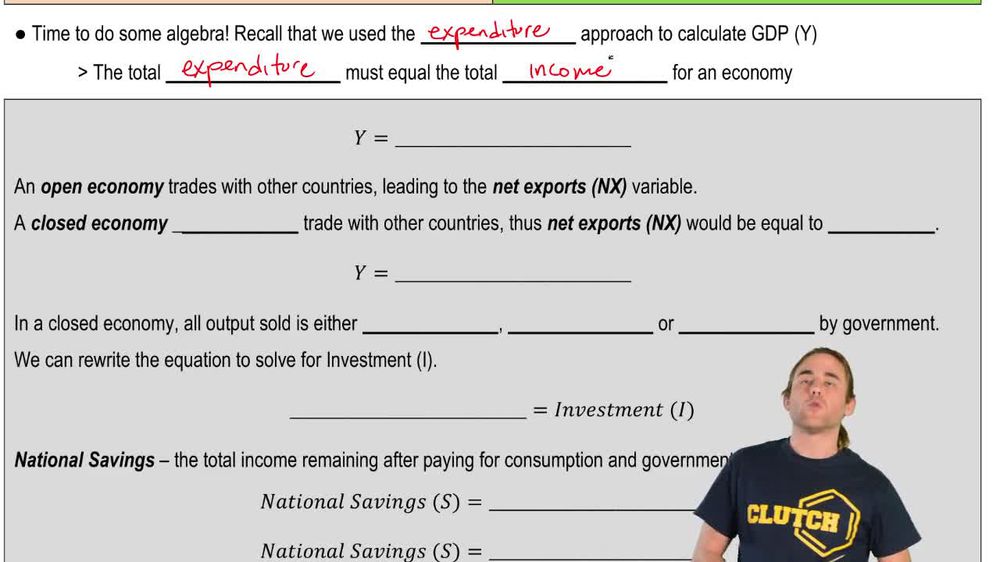
The GDP equation for an open economy is Y = C + I + G + NX, where NX is net exports.
How does the GDP equation change in a closed economy?
In a closed economy, net exports (NX) are zero, so the equation becomes Y = C + I + G.
How do you solve for investment (I) in a closed economy using the GDP equation?
Investment equals total income minus consumption and government purchases: I = Y - C - G.
What is national savings in a closed economy?
National savings is the total income left after subtracting consumption and government purchases: S = Y - C - G.
How is national savings divided?
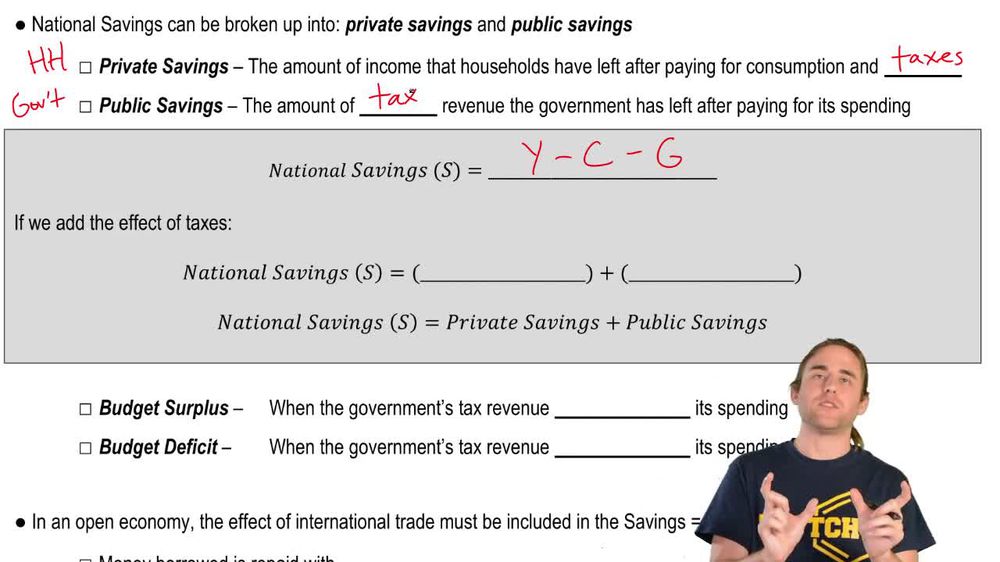
National savings is divided into private savings (by households) and public savings (by the government).
How do you calculate private savings?
Private savings is calculated as Y - C - T, where T is taxes paid by households.
How do you calculate public savings?
Public savings is calculated as T - G, where T is tax revenue and G is government spending.
What does a government budget surplus indicate?
A budget surplus means the government's tax revenue exceeds its spending (T > G), resulting in positive public savings.
What does a government budget deficit indicate?
A budget deficit means the government spends more than it collects in taxes (T < G), resulting in negative public savings.
How does the savings-investment identity change in an open economy?
In an open economy, investment equals national savings plus net capital inflow (I = S + NCI).
What is net capital inflow (NCI) and how does it relate to net exports?
Net capital inflow is the amount of foreign funds used to finance domestic investment, and it is the opposite of net exports (NCI = -NX).
What happens to investment if a country imports more than it exports?
If imports exceed exports, the country has a net capital inflow, which helps finance additional investment beyond national savings.
 Back
Back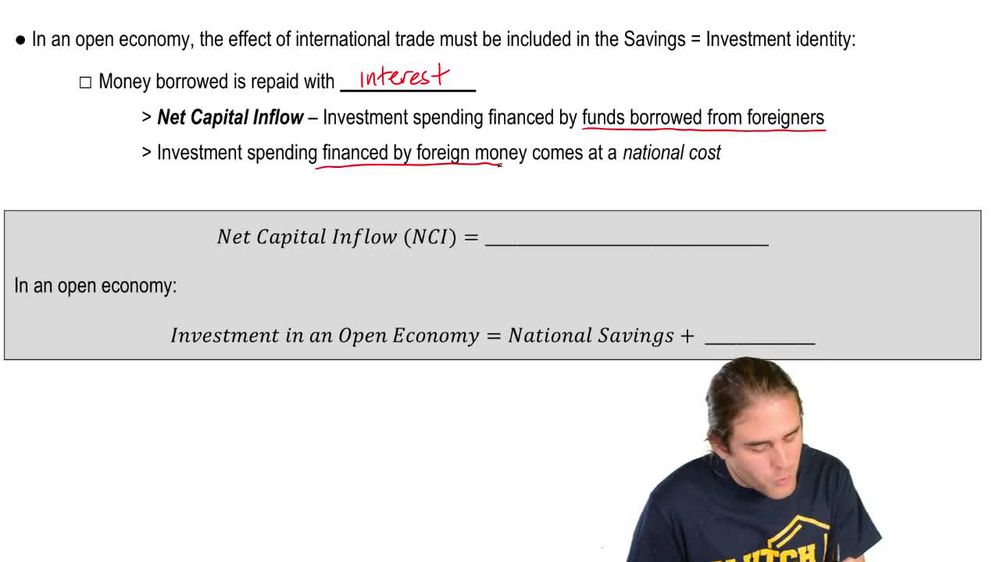
 03:56
03:56