Skip to main content
Microeconomics
My Course
Learn
Exam Prep
AI Tutor
Study Guides
Flashcards
Explore
Try the app
My Course
Learn
Exam Prep
AI Tutor
Study Guides
Flashcards
Explore
Try the app
Back
Required Reserves and the Deposit Multiplier quiz
You can tap to flip the card.
What is fractional reserve banking?
You can tap to flip the card.
👆
What is fractional reserve banking?
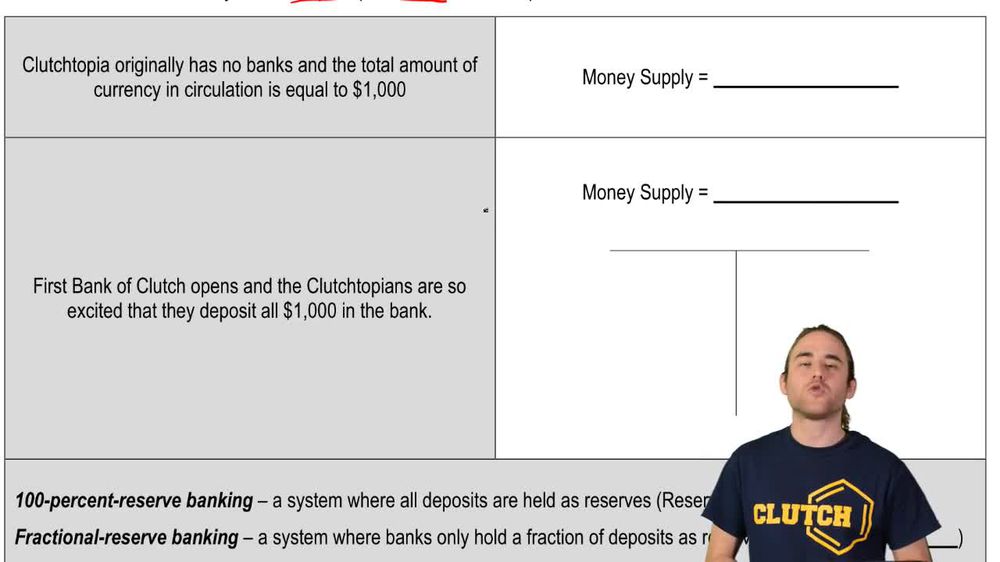
Fractional reserve banking is a system where banks keep only a fraction of deposits as reserves and loan out the rest.
Track progress
Control buttons has been changed to "navigation" mode.
1/15
Related flashcards
Recommended videos
Required Reserves and the Deposit Multiplier definitions
Required Reserves and the Deposit Multiplier
15 Terms
Guided course
03:16
Required Reserves and the Deposit Multiplier
Guided course
05:31
Bank Balance Sheet and Money Supply
Terms in this set (15)
Hide definitions
What is fractional reserve banking?
Fractional reserve banking is a system where banks keep only a fraction of deposits as reserves and loan out the rest.
How is the reserve ratio defined?
The reserve ratio is defined as the amount of reserves a bank holds divided by the total deposits.
What happens to the money supply when banks loan out excess reserves?
The money supply increases because the loaned money is deposited and re-loaned, multiplying the initial deposit.
What is a required reserve?
Required reserves are the minimum amount of reserves a bank is legally mandated to hold, based on the reserve ratio set by the government.
What are excess reserves?
Excess reserves are reserves held by a bank above the legal requirement.
How does the reserve ratio affect the money multiplier?
A lower reserve ratio increases the money multiplier, while a higher reserve ratio decreases it.
What is the formula for the money multiplier?
The money multiplier is calculated as 1 divided by the reserve ratio.
If the reserve ratio is 10%, what is the money multiplier?
The money multiplier is 10, since 1 divided by 0.10 equals 10.
What is the effect of a 100% reserve banking system on the money supply?
In a 100% reserve system, banks hold all deposits as reserves, so the money supply does not multiply.
How does an initial deposit of \$1,000 affect the money supply with a 10% reserve ratio?
It can increase the money supply by up to \$10,000 through repeated loans and deposits.
What happens to the size of loans as the deposit multiplier process continues?
The size of loans gets smaller with each round as the reserve requirement is applied to each new deposit.
What is included in the definition of the money supply (M1)?
M1 includes currency in circulation and checking account deposits.
Why do banks not expect all depositors to withdraw their money at once?
Because withdrawals are staggered and banks rely on reserves to meet typical withdrawal demands.
How does the government influence the reserve ratio?
The government mandates the minimum reserve ratio that banks must hold.
What is the main purpose of holding reserves in banks?
Reserves are held to meet withdrawal demands and comply with legal requirements.
 BackBack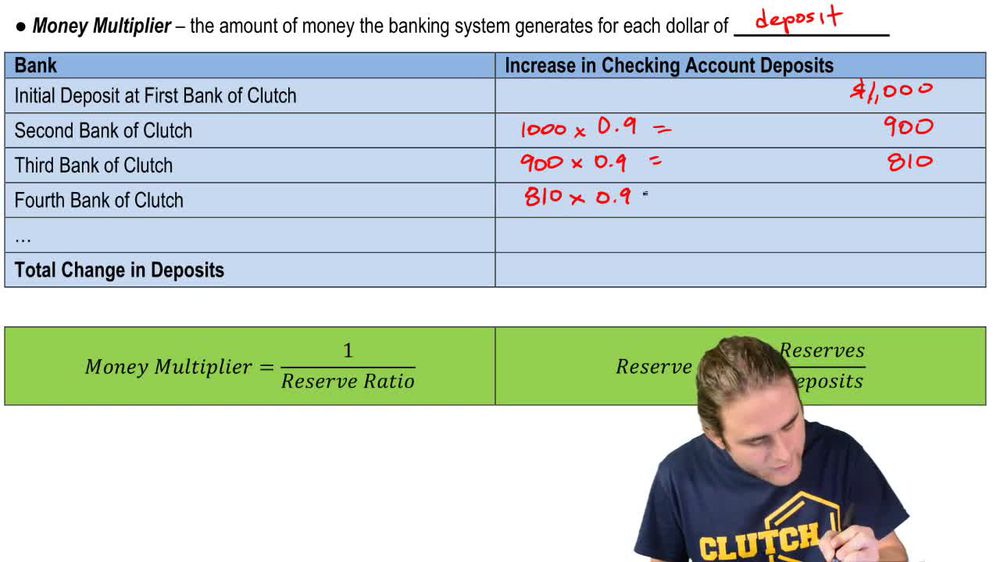
 03:16
03:16