Skip to main content
Microeconomics
My Course
Learn
Exam Prep
AI Tutor
Study Guides
Flashcards
Explore
Try the app
My Course
Learn
Exam Prep
AI Tutor
Study Guides
Flashcards
Explore
Try the app
Back
Required Reserves and the Deposit Multiplier definitions
You can tap to flip the card.
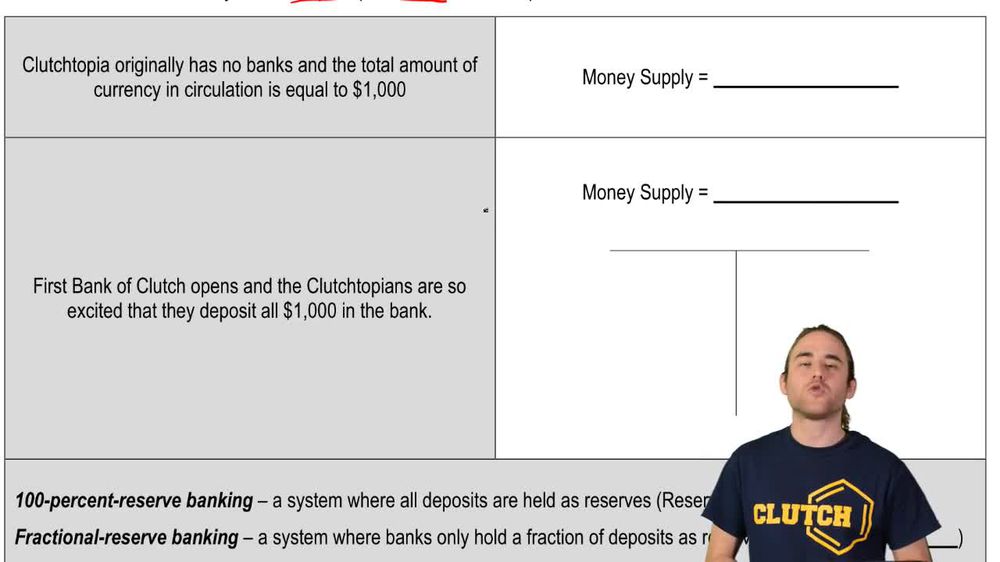
Money Supply
You can tap to flip the card.
👆
Money Supply
Total value of currency in circulation plus checking account deposits, reflecting the amount of money available in the economy.
Track progress
Control buttons has been changed to "navigation" mode.
1/15
Related flashcards
Recommended videos
Required Reserves and the Deposit Multiplier quiz
Required Reserves and the Deposit Multiplier
15 Terms
Guided course
03:16
Required Reserves and the Deposit Multiplier
Guided course
05:31
Bank Balance Sheet and Money Supply
Terms in this set (15)
Hide definitions
Money Supply
Total value of currency in circulation plus checking account deposits, reflecting the amount of money available in the economy.
Checking Account Deposit
Funds placed in a bank account that can be withdrawn or used for payments, contributing to the money supply.
Fractional Reserve Banking
System where banks keep only a portion of deposits as reserves and loan out the remainder, enabling money creation.
Reserve Ratio
Proportion of deposits banks must hold as reserves, calculated as reserves divided by total deposits.
Required Reserves
Minimum amount of reserves a bank must legally maintain, determined by government regulations.
Excess Reserves
Funds held by a bank above the mandated minimum, available for lending or other uses.
Money Multiplier
Factor showing how an initial deposit can expand the money supply, calculated as one divided by the reserve ratio.
Asset
Resource owned by a bank, such as cash or loans, used to balance liabilities and support operations.
Liability
Obligation a bank owes, typically deposits from customers that must be available for withdrawal.
Deposit Multiplier
Process by which repeated lending and depositing amplifies the initial deposit, increasing the money supply.
Currency in Circulation
Physical money, such as coins and bills, actively used outside banks in the economy.
Balance Sheet
Financial statement showing a bank’s assets and liabilities, used to track reserves and loans.
Loan
Amount lent by a bank from excess reserves, increasing money supply as recipients spend or deposit funds.
Reserve Requirement
Government-imposed rule specifying the minimum fraction of deposits banks must keep as reserves.
100% Reserve Banking
System where banks hold all deposits as reserves, preventing money supply expansion through lending.
 BackBack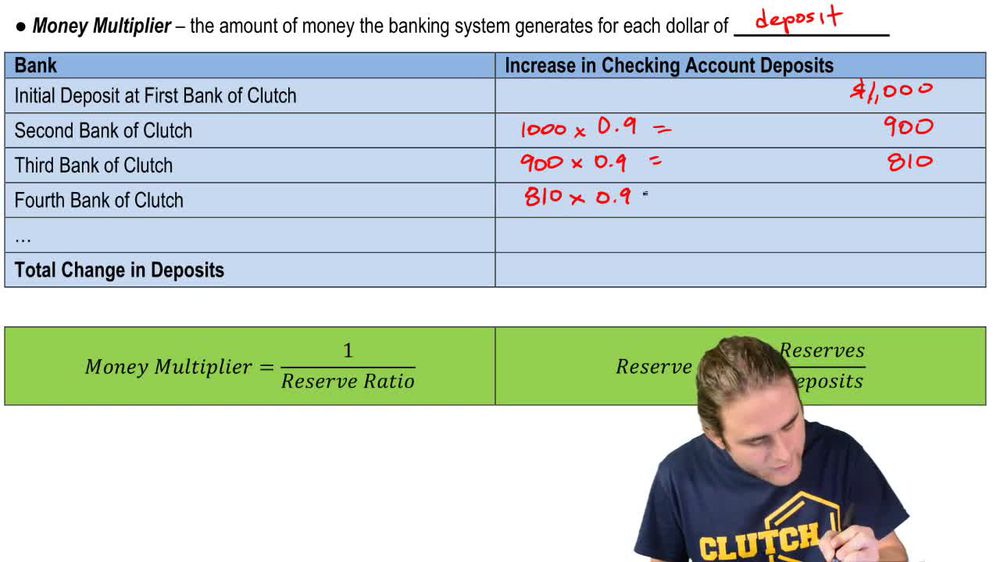
 03:16
03:16