Skip to main content
Microeconomics
My Course
Learn
Exam Prep
AI Tutor
Study Guides
Flashcards
Explore
Try the app
My Course
Learn
Exam Prep
AI Tutor
Study Guides
Flashcards
Explore
Try the app
Back
Real Business Cycle Model quiz
You can tap to flip the card.
What does the Real Business Cycle Model focus on as the main cause of economic fluctuations?
You can tap to flip the card.
👆
What does the Real Business Cycle Model focus on as the main cause of economic fluctuations?
It focuses on changes in aggregate supply, especially due to technology or resource availability.
Track progress
Control buttons has been changed to "navigation" mode.
1/15
Related flashcards
Recommended videos
Real Business Cycle Model definitions
Real Business Cycle Model
15 Terms
Guided course
03:54
Real Business Cycle Model
Terms in this set (15)
Hide definitions
What does the Real Business Cycle Model focus on as the main cause of economic fluctuations?
It focuses on changes in aggregate supply, especially due to technology or resource availability.
How does the Real Business Cycle Model explain recessions?
It explains recessions as resulting from negative supply shocks, such as increased input prices or reduced resource availability.
What is a supply shock in the context of the Real Business Cycle Model?
A supply shock is a sudden change in resource availability or input prices that shifts aggregate supply.
How does an increase in oil prices affect the economy according to the Real Business Cycle Model?
It raises input costs, reduces production and employment, and shifts long-run aggregate supply to the left.
What happens to real GDP when there is a negative supply shock in the Real Business Cycle Model?
Real GDP decreases due to the reduction in aggregate supply.
How does the Real Business Cycle Model differ from the Keynesian Model?
The Real Business Cycle Model focuses on aggregate supply changes, while the Keynesian Model focuses on aggregate demand changes.
What role does technology play in the Real Business Cycle Model?
Changes in technology can increase or decrease aggregate supply, causing economic fluctuations.
According to the Real Business Cycle Model, what happens to the price level after a supply shock?
The price level remains constant even though real GDP falls.
How does a reduction in production affect aggregate demand in the Real Business Cycle Model?
A reduction in production leads to lower employment and income, which then reduces aggregate demand.
What is the main driver of economic changes in the Real Business Cycle Model?
Aggregate supply is the main driver of economic changes in this model.
How do monetarist models explain economic fluctuations compared to the Real Business Cycle Model?
Monetarist models focus on changes in the money supply and spending, while the Real Business Cycle Model focuses on supply-side factors.
What happens to employment when there is a negative supply shock in the Real Business Cycle Model?
Employment decreases as production falls due to the supply shock.
In the Real Business Cycle Model, what causes the long-run aggregate supply curve to shift left?
A decrease in resource availability or an increase in input prices causes the long-run aggregate supply curve to shift left.
What is the effect on market equilibrium when aggregate supply decreases in the Real Business Cycle Model?
Market equilibrium shifts to a lower real GDP with the same price level.
Why does the Real Business Cycle Model not focus on aggregate demand for explaining recessions?
It believes supply-side factors, not demand-side changes, are the primary cause of economic fluctuations.
 BackBack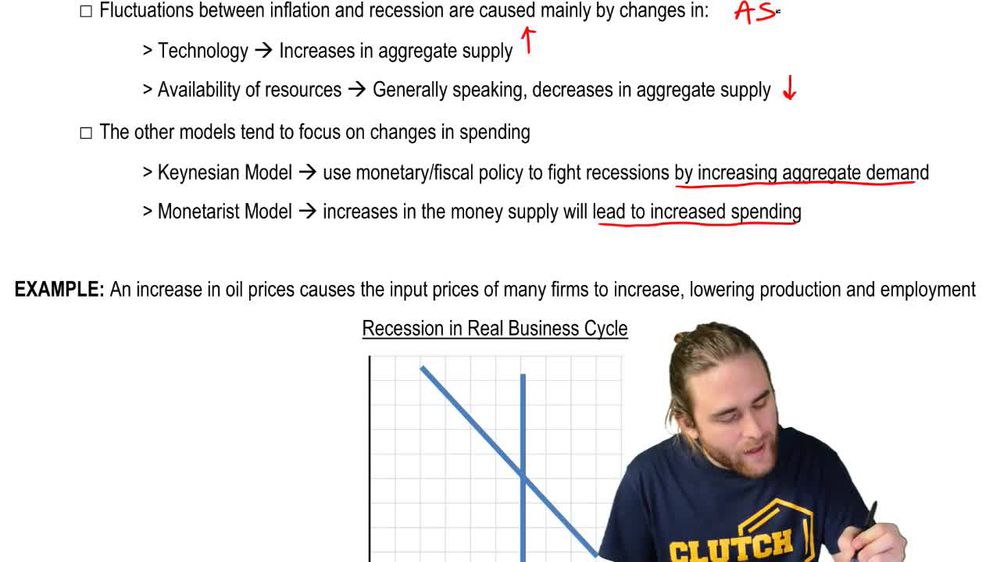
 03:54
03:54