Skip to main content
Microeconomics
My Course
Learn
Exam Prep
AI Tutor
Study Guides
Flashcards
Explore
Try the app
My Course
Learn
Exam Prep
AI Tutor
Study Guides
Flashcards
Explore
Try the app
Back
Quantity Theory of Money quiz
You can tap to flip the card.
What is the equation for the quantity theory of money?
You can tap to flip the card.
👆
What is the equation for the quantity theory of money?
The equation is M × V = P × Y, where M is money supply, V is velocity of money, P is price level, and Y is real GDP.
Track progress
Control buttons has been changed to "navigation" mode.
1/15
Related flashcards
Recommended videos
Quantity Theory of Money definitions
Quantity Theory of Money
15 Terms
Guided course
04:25
Quantity Theory of Money
1
views
Guided course
05:17
Quantity Theory of Money and Inflation
1
views
Terms in this set (15)
Hide definitions
What is the equation for the quantity theory of money?
The equation is M × V = P × Y, where M is money supply, V is velocity of money, P is price level, and Y is real GDP.
What does the velocity of money (V) represent in the quantity theory of money?
It represents the average number of times each dollar is spent in the economy during a year.
If the money supply grows faster than real GDP, what happens to the price level?
The price level increases, resulting in inflation.
What happens to prices if real GDP grows faster than the money supply?
Prices decrease, leading to deflation.
What does it mean if the money supply and real GDP grow at the same rate?
It means prices remain stable, with no inflation or deflation.
How is the price level (P) defined in the quantity theory of money?
The price level is a measure of the average prices of goods and services in the economy.
What is real GDP (Y) in the context of the quantity theory of money?
Real GDP is the total value of all goods and services produced in the economy, adjusted for inflation.
How can you solve for the velocity of money if you know M, P, and Y?
You can solve for V by dividing P × Y by M (V = (P × Y) / M).
Why is the velocity of money often assumed to be constant in the quantity theory of money?
Because spending habits, such as how often people get paid or shop, tend to be stable over time.
What does the price deflator measure in the context of the quantity theory of money?
It measures the change in prices relative to a base year, indicating inflation or deflation.
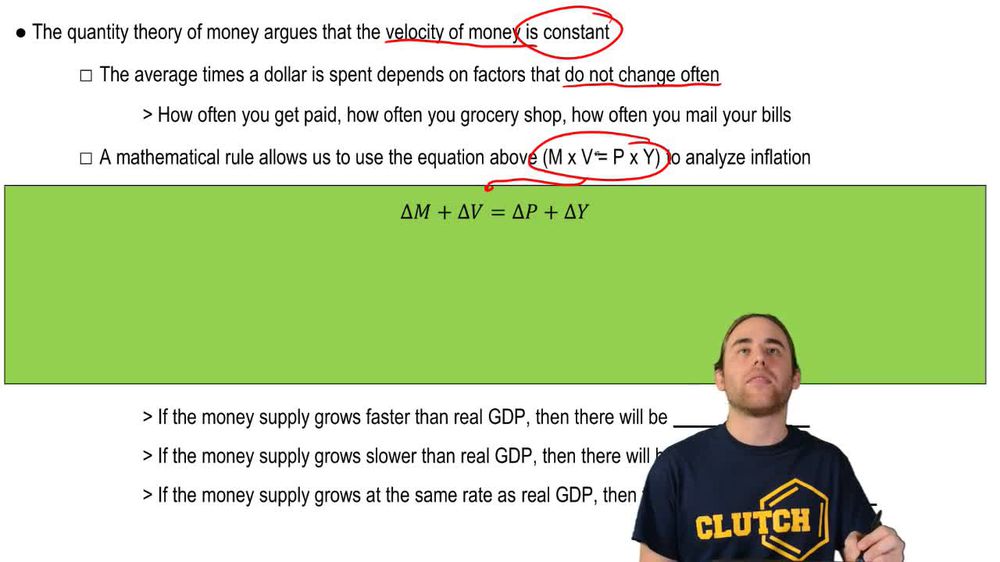
How does the quantity theory of money help analyze inflation?
It shows that inflation occurs when the money supply grows faster than real GDP, assuming velocity is constant.
What is the mathematical identity used to analyze changes in the quantity theory of money variables?
The change in money supply plus the change in velocity equals the change in prices plus the change in GDP.
If the velocity of money does not change, how does the equation for changes in variables simplify?
It simplifies to: change in money supply minus change in GDP equals change in prices (inflation).
What is the main conclusion of the quantity theory of money regarding price stability?
Price stability occurs when the money supply and real GDP grow at the same rate.
How can the quantity theory of money equation be used in practice?
It can be used to solve for any one variable if the others are known, or to analyze how changes in money supply and GDP affect inflation.
 BackBack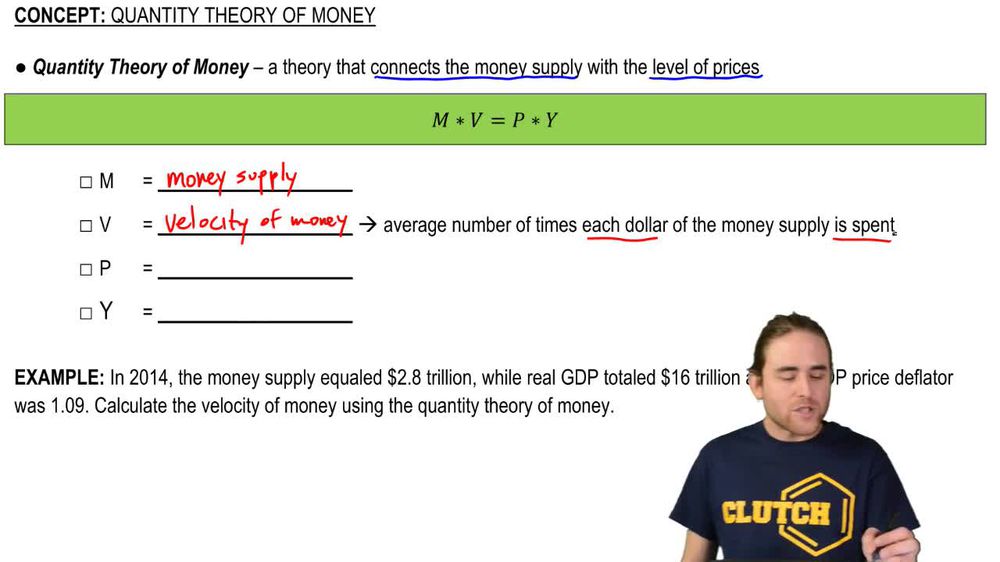
 04:25
04:25