Skip to main content
Microeconomics
My Course
Learn
Exam Prep
AI Tutor
Study Guides
Flashcards
Explore
Try the app
My Course
Learn
Exam Prep
AI Tutor
Study Guides
Flashcards
Explore
Try the app
Back
Quantity Theory of Money definitions
You can tap to flip the card.
Quantity Theory of Money
You can tap to flip the card.
👆
Quantity Theory of Money
A model linking the amount of money in circulation to overall price levels and economic output using a simple equation.
Track progress
Control buttons has been changed to "navigation" mode.
1/15
Related flashcards
Recommended videos
Quantity Theory of Money quiz
Quantity Theory of Money
15 Terms
Guided course
04:25
Quantity Theory of Money
1
views
Guided course
05:17
Quantity Theory of Money and Inflation
1
views
Terms in this set (15)
Hide definitions
Quantity Theory of Money
A model linking the amount of money in circulation to overall price levels and economic output using a simple equation.
Money Supply
The total amount of currency available in an economy, typically determined by central authorities like the Fed.
Velocity of Money
The average frequency each unit of currency is used for transactions within a year, reflecting how quickly money circulates.
Price Level
A measure indicating the average prices of goods and services in an economy, often compared to a base year.
Real GDP
Economic output adjusted for price changes, representing the value of goods and services at constant prices.
Inflation
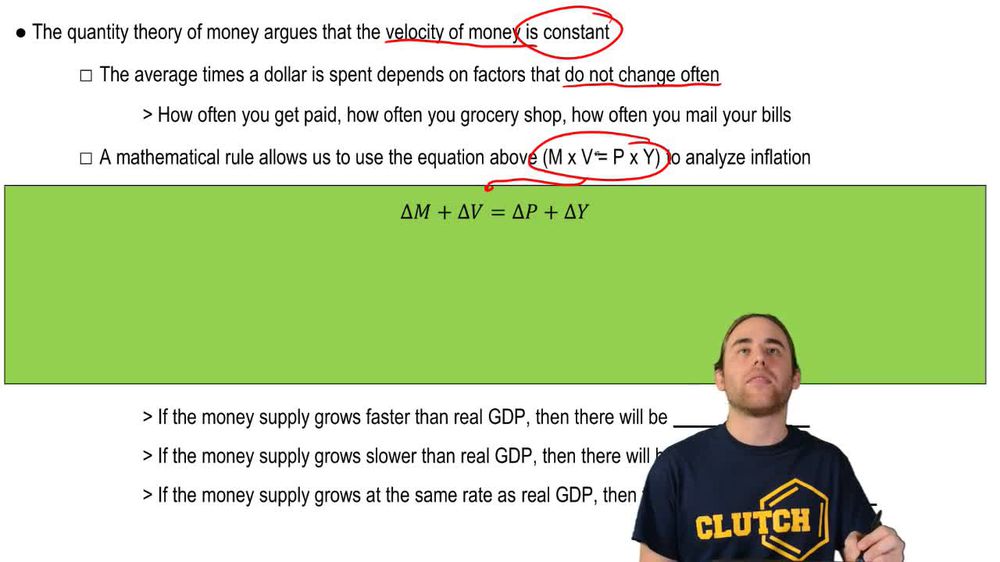
A sustained increase in the general price level, occurring when money supply grows faster than economic output.
Deflation
A decrease in the general price level, resulting when economic output grows faster than the money supply.
Stable Prices
A condition where the money supply and economic output grow at equal rates, keeping average prices unchanged.
Price Deflator
An index used to adjust nominal values to real values, showing how much prices have changed since a base year.
Macroeconomic Variables
Key indicators such as money supply, price level, and GDP that describe the overall performance of an economy.
Mathematical Identity
A relationship allowing the transformation of the quantity theory equation from multiplication to addition for analyzing changes.
Base Year
A reference period used for comparing price levels and economic output, providing a benchmark for measuring changes.
Central Authority
An institution, like the Federal Reserve, responsible for setting and regulating the money supply in an economy.
Economic Output
The total value of goods and services produced in an economy, often measured by real GDP.
Circulation
The movement of money through transactions, reflecting how often currency changes hands within a given period.
 BackBack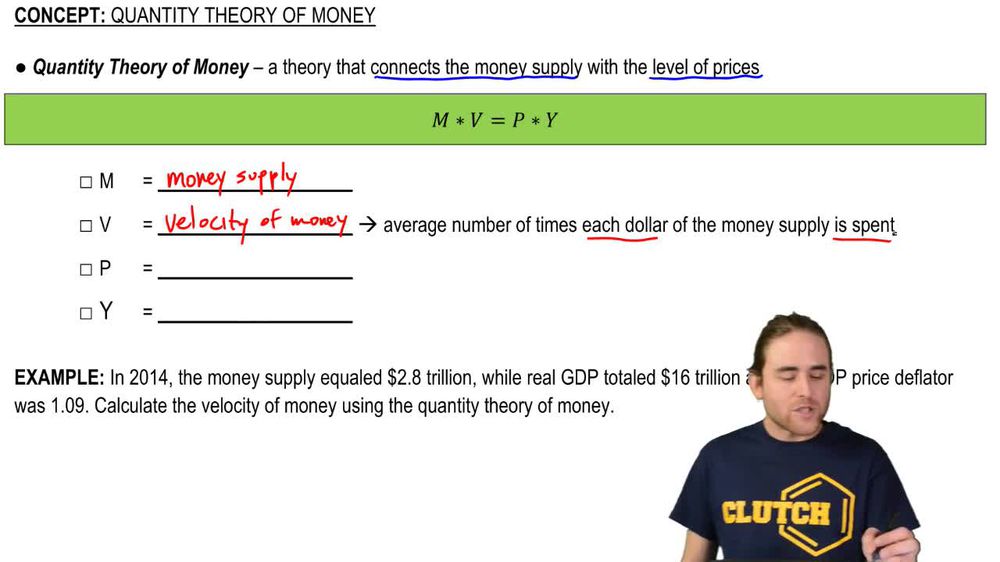
 04:25
04:25