Back

Quantitative Analysis of Price Ceilings and Price Floors: Finding Areas quiz

Control buttons has been changed to "navigation" mode.
1/15
  • When is a price floor considered effective in a market?

    A price floor is effective when it is set above the equilibrium price, causing it to impact market outcomes.
  • Where is consumer surplus located at equilibrium on a supply and demand graph?

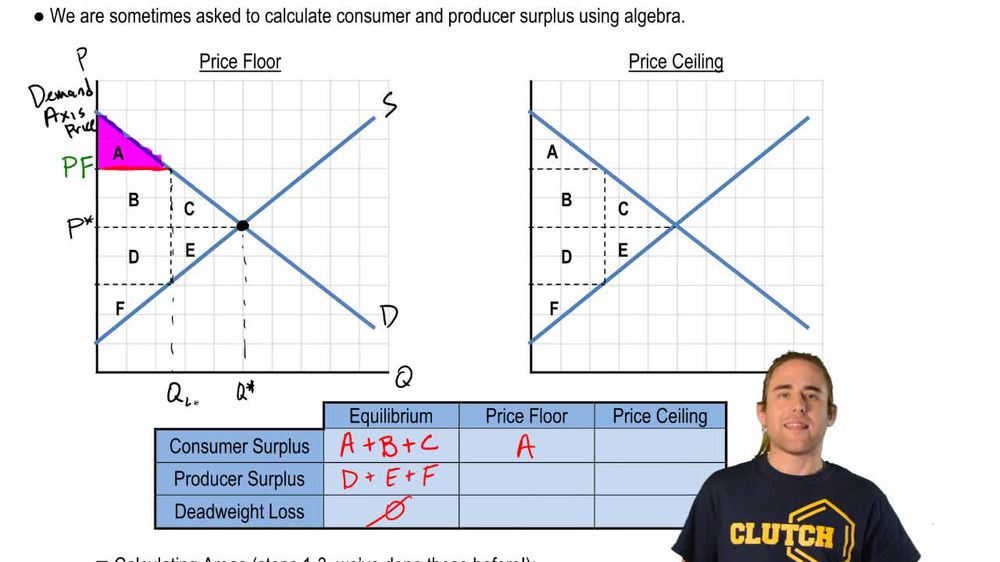
    Consumer surplus at equilibrium is the area above the equilibrium price and below the demand curve.
  • What happens to producer surplus when a price floor is imposed above equilibrium?

    Producer surplus becomes the area below the price floor and above the supply curve, but only up to the lower quantity traded; it excludes areas where trades do not occur.
  • How is deadweight loss represented on a graph with a price floor?

    Deadweight loss is shown as the areas corresponding to trades that do not occur due to the price floor, typically labeled as areas C and E.
  • What key prices do you need to calculate surpluses and deadweight loss with a price floor?

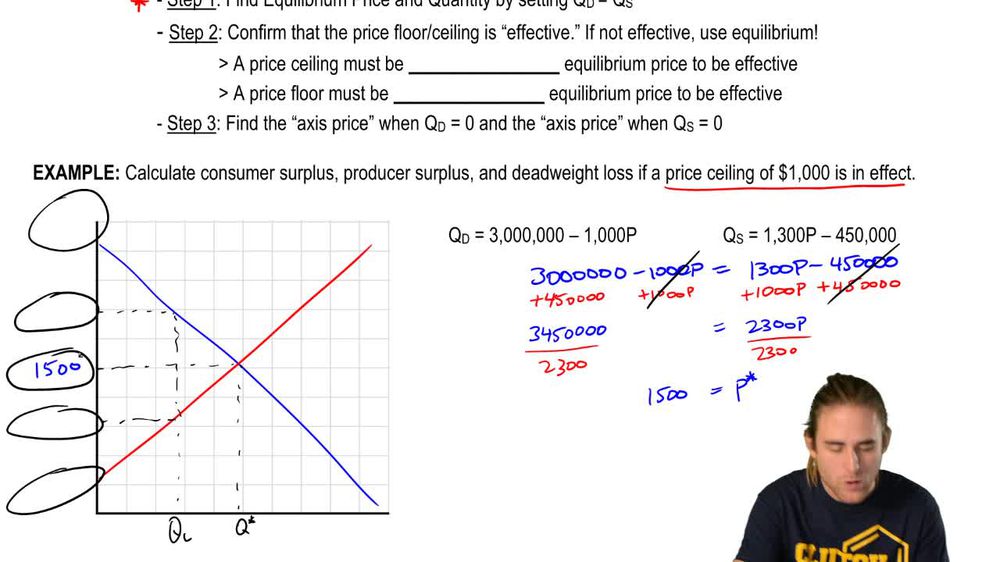
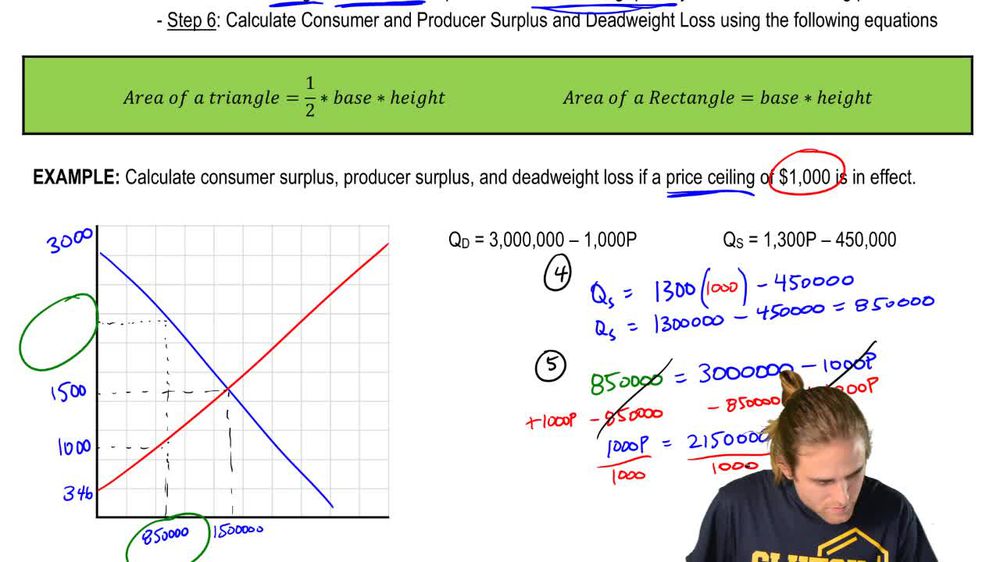
    You need the demand axis price, supply axis price, equilibrium price, the price floor, and a 'missing price' to perform these calculations.
  • What is the 'missing price' in the context of price floors and ceilings?

    The 'missing price' is an additional price point on the graph needed to calculate certain areas, such as surpluses or deadweight loss, and its location varies depending on the scenario.
  • How does a price ceiling affect consumer surplus compared to equilibrium?

    With a price ceiling, consumer surplus includes areas above the ceiling price and below the demand curve, but only up to the lower quantity traded, typically labeled as A, B, and D.
  • What is the only area representing producer surplus under a price ceiling?

    Producer surplus is limited to the area below the ceiling price and above the supply curve, usually labeled as F.
  • How do you calculate the area of consumer surplus or producer surplus when the shape is irregular?

    You split the area into simpler shapes, such as rectangles and triangles, and calculate each separately before adding them together.
  • What is deadweight loss under a price ceiling and how is it calculated?

    Deadweight loss is the sum of the areas representing lost trades (C and E), and is calculated using the difference between equilibrium and lower quantities, along with relevant prices.
  • Why do areas C and E not count toward surplus under price controls?

    Areas C and E represent trades that do not occur due to the price control, so no surplus is generated from them.
  • What quantities are necessary to calculate surpluses and deadweight loss under price controls?

    You need the equilibrium quantity (Q*) and the lower quantity traded due to the price control (QL).
  • How does the calculation of surpluses under price controls relate to previous concepts in microeconomics?

    The calculations use previously learned concepts like demand and supply axis prices, equilibrium price, and quantities, with the addition of the 'missing price.'
  • What is the effect of a price floor on consumer surplus?

    A price floor reduces consumer surplus to only the area above the floor price and below the demand curve, typically labeled as area A.
  • Why is it important to use a graph when calculating areas under price controls?

    A graph helps visualize and correctly identify the relevant areas and prices needed for accurate calculation of surpluses and deadweight loss.