What does a perfectly elastic supply curve look like on a graph?
A perfectly elastic supply curve is a horizontal line, indicating that suppliers will supply any quantity at a specific price.
How does the rotation of supply curves differ from demand curves?
Supply curves slope upward, so as elasticity changes, the rotation moves from horizontal to vertical in the opposite direction compared to the downward-sloping demand curves.
What does it mean when a supply curve cuts through the price axis?
When a supply curve cuts through the price axis, it is considered elastic, with a price elasticity of supply greater than 1.
Where does a unit elastic supply curve cut through on a graph?
A unit elastic supply curve cuts through the origin, where the price and quantity axes meet.
What is the price elasticity of supply for a unit elastic supply curve?
The price elasticity of supply for a unit elastic supply curve is exactly 1.
How can you identify an inelastic supply curve on a graph?
An inelastic supply curve cuts through the quantity axis and becomes steeper as it approaches perfect inelasticity.
What does a perfectly inelastic supply curve look like?
A perfectly inelastic supply curve is a vertical line, indicating that quantity supplied does not change regardless of price.
What is the price elasticity of supply for a perfectly elastic supply curve?
The price elasticity of supply for a perfectly elastic supply curve is greater than 1, often considered infinite.
What happens to the steepness of the supply curve as it becomes more inelastic?
As the supply curve becomes more inelastic, it becomes steeper, eventually becoming a vertical line.
How do you determine the elasticity of a supply curve by looking at where it cuts the axes?
If the supply curve cuts the price axis, it is elastic; if it cuts the origin, it is unit elastic; if it cuts the quantity axis, it is inelastic.
What is the significance of a supply curve that is a horizontal line?
A horizontal supply curve means suppliers are willing to supply any amount at a fixed price, showing perfect elasticity.
What is the significance of a supply curve that is a vertical line?
A vertical supply curve means the quantity supplied is fixed and does not respond to price changes, showing perfect inelasticity.
How does the supply curve transition from perfectly elastic to perfectly inelastic?
The supply curve transitions from a horizontal line (perfectly elastic), to sloped lines (elastic, unit elastic, inelastic), to a vertical line (perfectly inelastic) as elasticity decreases.
What does it mean if a supply curve is described as 'elastic'?
An elastic supply curve means that the percentage change in quantity supplied is greater than the percentage change in price (elasticity > 1).
Why is the direction of rotation for supply curves different from demand curves?
The direction is different because supply curves slope upward, while demand curves slope downward, affecting how elasticity changes are represented graphically.
 Back
Back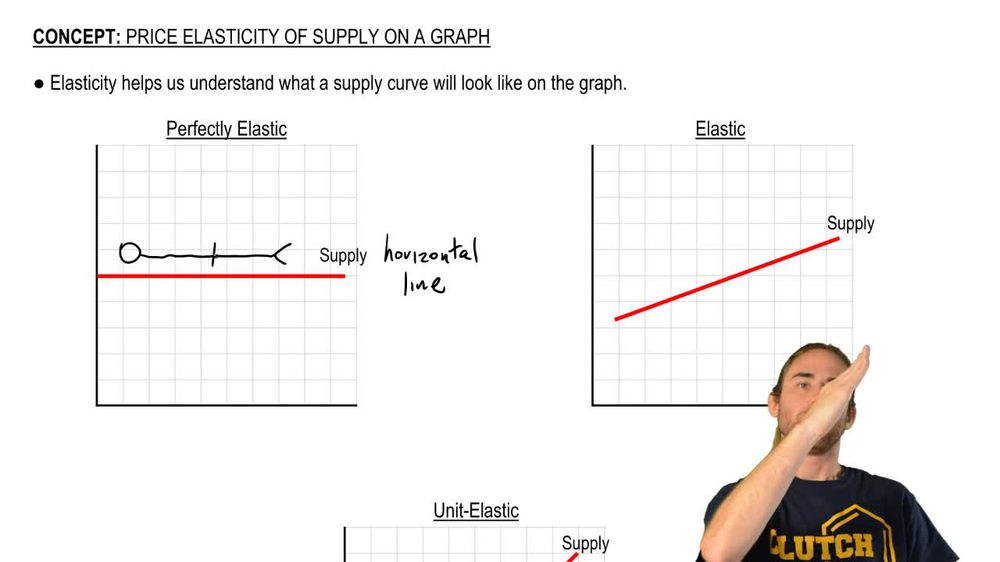
 03:46
03:46