Skip to main content
Microeconomics
My Course
Learn
Exam Prep
AI Tutor
Study Guides
Flashcards
Explore
Try the app
My Course
Learn
Exam Prep
AI Tutor
Study Guides
Flashcards
Explore
Try the app
Back
Percentage and Decimal Review quiz
You can tap to flip the card.
How do you convert a percentage to a decimal?
You can tap to flip the card.
👆
How do you convert a percentage to a decimal?
Move the decimal point two places to the left. For example, 50% becomes 0.50.
Track progress
Control buttons has been changed to "navigation" mode.
1/15
Related flashcards
Related practice
Recommended videos
Percentage and Decimal Review definitions
Percentage and Decimal Review
14 Terms
Percentage and Decimal Review
1. Reading and Understanding Graphs
9 problems
Topic
Fractions Review
1. Reading and Understanding Graphs
10 problems
Topic
1. Reading and Understanding Graphs
9 topics
15 problems
Chapter
Guided course
05:14
Converting Percentages and Decimals
12
views
Terms in this set (15)
Hide definitions
How do you convert a percentage to a decimal?
Move the decimal point two places to the left. For example, 50% becomes 0.50.
How do you convert a decimal to a percentage?
Move the decimal point two places to the right. For example, 0.34 becomes 34%.
Where is the implied decimal point in a whole number like 16?
The decimal point is implied at the end of the number, after the 6.
What is 1.25% as a decimal?
1.25% as a decimal is 0.0125.
What is 120% as a decimal?
120% as a decimal is 1.2.
What is 5% as a decimal?
5% as a decimal is 0.05.
What is 0.5% as a decimal?
0.5% as a decimal is 0.005.
What is 100% as a decimal?
100% as a decimal is 1.
What is 0.34 as a percentage?
0.34 as a percentage is 34%.
What is 0.61 as a percentage?
0.61 as a percentage is 61%.
What is 0.06 as a percentage?
0.06 as a percentage is 6%.
What is 0.4512 as a percentage?
0.4512 as a percentage is 45.12%.
What is 0.0004 as a percentage?
0.0004 as a percentage is 0.04%.
What is 1 as a percentage?
1 as a percentage is 100%.
Why is it important to compare numbers like 5%, 50%, and 0.5%?
Comparing these helps you understand the difference in scale between similar-looking numbers after conversion.
 BackBack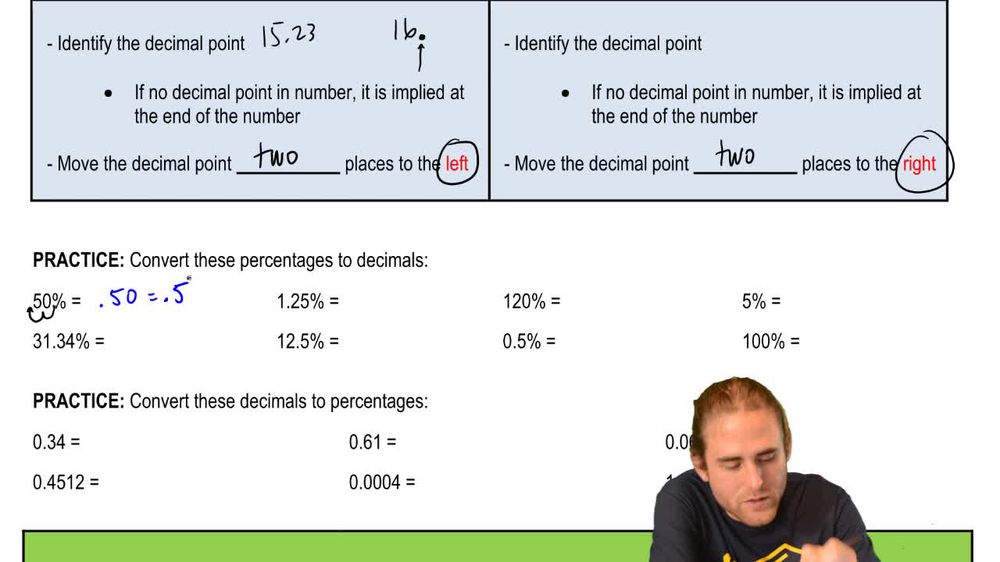
 05:14
05:14