Skip to main content
Microeconomics
My Course
Learn
Exam Prep
AI Tutor
Study Guides
Flashcards
Explore
Try the app
My Course
Learn
Exam Prep
AI Tutor
Study Guides
Flashcards
Explore
Try the app
Back
Percentage and Decimal Review definitions
You can tap to flip the card.
Percentage
You can tap to flip the card.
👆
Percentage
A number expressed as parts per hundred, often used to compare proportions or rates in various contexts.
Track progress
Control buttons has been changed to "navigation" mode.
1/14
Related flashcards
Related practice
Recommended videos
Percentage and Decimal Review quiz
Percentage and Decimal Review
15 Terms
Percentage and Decimal Review
1. Reading and Understanding Graphs
9 problems
Topic
Fractions Review
1. Reading and Understanding Graphs
10 problems
Topic
1. Reading and Understanding Graphs
9 topics
15 problems
Chapter
Guided course
05:14
Converting Percentages and Decimals
12
views
Terms in this set (14)
Hide definitions
Percentage
A number expressed as parts per hundred, often used to compare proportions or rates in various contexts.
Decimal
A numerical representation based on powers of ten, often used to express fractions or parts of a whole.
Decimal Point
A symbol separating whole numbers from fractional parts, crucial for conversions between percentages and decimals.
Implied Decimal
A concept where the decimal point is assumed to be at the end of a whole number if not visibly shown.
Conversion
A process involving changing a number from one form, such as percentage, to another, like decimal.
Scale
A relative size or level used to compare values, such as distinguishing between 5%, 50%, and 0.5%.
Place Value
A positional system determining the value of digits in a number, essential for moving the decimal point.
Practice Exercise
An activity designed to reinforce understanding by applying conversion methods between percentages and decimals.
Simplification
A process of reducing a number to its most concise form, such as dropping unnecessary zeros in decimals.
Hundredth
A fractional value representing one part out of one hundred, often encountered in decimal and percentage conversions.
Comparison
An analytical approach to evaluate differences in magnitude between numbers like 5%, 50%, and 0.5%.
Fraction
A numerical expression representing a part of a whole, closely related to decimals and percentages.
Whole Number
A number without fractional or decimal parts, often used as a starting point for implied decimal placement.
Zero
A digit used to fill empty place values when moving the decimal point during conversions.
 BackBack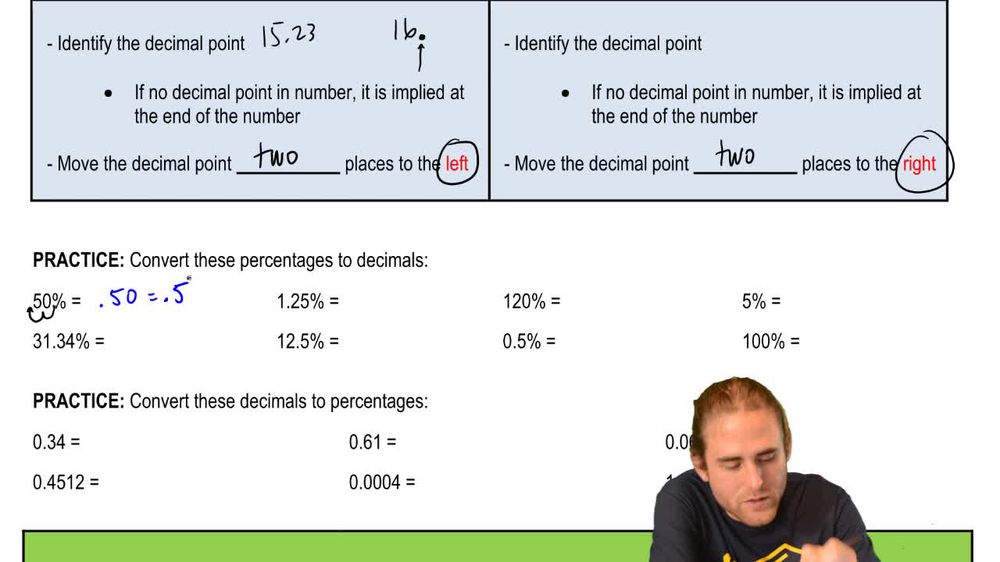
 05:14
05:14