Skip to main content
Microeconomics
My Course
Learn
Exam Prep
AI Tutor
Study Guides
Flashcards
Explore
Try the app
My Course
Learn
Exam Prep
AI Tutor
Study Guides
Flashcards
Explore
Try the app
Back
New Classical Model definitions
You can tap to flip the card.
Potential GDP
You can tap to flip the card.
👆
Potential GDP
Represents the maximum output an economy can achieve when all resources are fully employed and operating efficiently.
Track progress
Control buttons has been changed to "navigation" mode.
1/15
Related flashcards
Recommended videos
New Classical Model quiz
New Classical Model
15 Terms
Guided course
04:33
New Classical Model
Terms in this set (15)
Hide definitions
Potential GDP
Represents the maximum output an economy can achieve when all resources are fully employed and operating efficiently.
Full Employment
Occurs when all available labor resources are being used in the most efficient way, with minimal cyclical unemployment.
Flexible Wages
Describes compensation that can quickly adjust in response to changes in supply and demand within the labor market.
Flexible Prices
Refers to the ability of goods and services' prices to rapidly change in response to market conditions.
Rational Expectations
Involves economic agents using all available information to predict future variables, influencing current decisions.
Inflation Expectations
Represents beliefs about future price increases, affecting wage negotiations and business planning.
Actual Inflation
Measures the real rate at which prices rise over a period, impacting economic outcomes when differing from forecasts.
Short-Run Phillips Curve
Illustrates the relationship between inflation and unemployment, shifting when expectations about inflation change.
Monetary Growth Rule
A guideline for steady increases in money supply, aiming to stabilize economic expectations and outcomes.
Money Supply
Total amount of monetary assets available in an economy, influencing inflation and economic activity.
Market Equilibrium
Occurs when supply and demand balance, resulting in stable prices and efficient resource allocation.
Monetarist Model
Emphasizes the role of money supply in determining economic performance and supports steady monetary expansion.
Classical Model
Suggests economies naturally operate at full employment with flexible prices and minimal government intervention.
Keynesian Model
Focuses on sticky prices and wages, advocating government action to address recessions and inflation.
Economic Repercussions
Consequences arising from mismatches between expected and actual economic variables, affecting unemployment and inflation.
 BackBack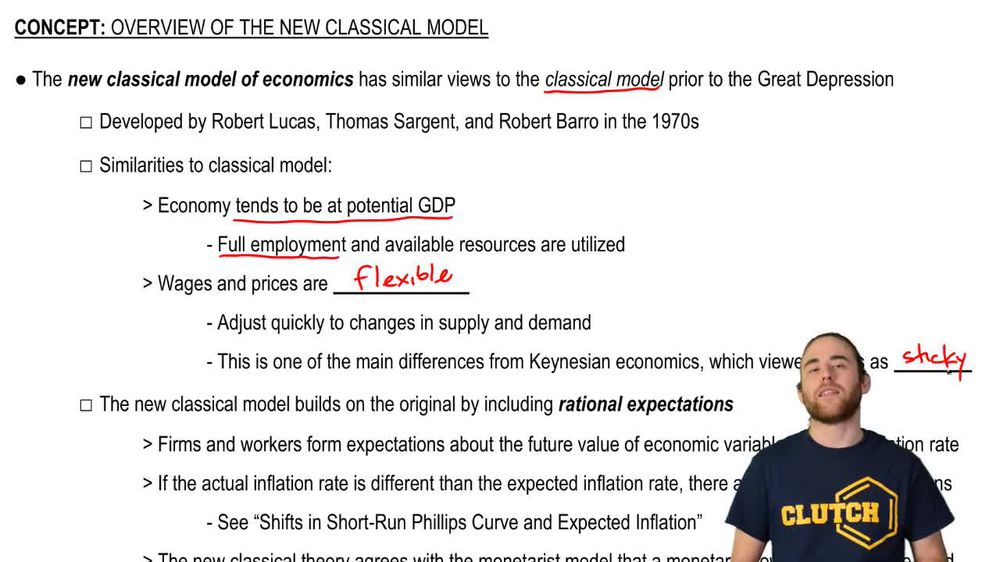
 04:33
04:33