Skip to main content
Microeconomics
My Course
Learn
Exam Prep
AI Tutor
Study Guides
Flashcards
Explore
Try the app
My Course
Learn
Exam Prep
AI Tutor
Study Guides
Flashcards
Explore
Try the app
Back
Monetary vs Fiscal Policy quiz
You can tap to flip the card.
Who is responsible for implementing monetary policy?
You can tap to flip the card.
👆
Who is responsible for implementing monetary policy?
The nation's central bank is responsible for implementing monetary policy.
Track progress
Control buttons has been changed to "navigation" mode.
1/15
Related flashcards
Recommended videos
Monetary vs Fiscal Policy definitions
Monetary vs Fiscal Policy
15 Terms
03:13
Monetary vs Fiscal Policy
1
views
Terms in this set (15)
Hide definitions
Who is responsible for implementing monetary policy?
The nation's central bank is responsible for implementing monetary policy.
Who manages fiscal policy in an economy?
Fiscal policy is managed by government policymakers or elected officials.
What are the two main tools used to address economic decline?
The two main tools are monetary policy and fiscal policy.
How does the central bank influence consumer spending through monetary policy?
The central bank can adjust interest rates and the money supply to influence consumer spending.
What effect does lowering interest rates have on consumer purchases?
Lowering interest rates makes borrowing cheaper, encouraging consumers to make purchases.
How can fiscal policy help someone buy a new car during economic decline?
Fiscal policy can provide tax breaks or stipends, increasing disposable income and making it easier to afford a car.
What are the main levers of fiscal policy?
The main levers of fiscal policy are taxes and government spending.
How do monetary and fiscal policies impact GDP?
Both policies stimulate spending, which keeps companies productive and increases GDP.
Why does increased consumer spending help maintain employment?
Increased spending keeps companies productive, which helps them retain employees.
How can monetary and fiscal policies affect inflation?
By influencing spending and demand, these policies can help stabilize or change inflation rates.
Which policy is generally faster to implement: monetary or fiscal?
Monetary policy is generally faster to implement because the central bank can act quickly.
Why is monetary policy considered more politically neutral than fiscal policy?
Monetary policy is managed by the central bank, which is less influenced by political processes than elected officials.
What is a potential drawback of fiscal policy compared to monetary policy?
Fiscal policy often requires political approval and can be slower and more politically charged.
How do tax breaks under fiscal policy influence consumer behavior?
Tax breaks increase disposable income, making consumers more likely to spend.
What is the overall goal of using monetary and fiscal policy during economic downturns?
The goal is to stimulate demand, maintain employment, and stabilize inflation to manage market equilibrium and reduce economic losses.
 BackBack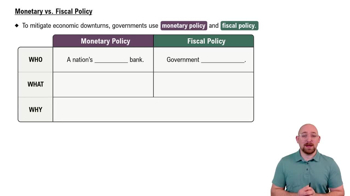
 03:13
03:13