Skip to main content
Microeconomics
My Course
Learn
Exam Prep
AI Tutor
Study Guides
Flashcards
Explore
Try the app
My Course
Learn
Exam Prep
AI Tutor
Study Guides
Flashcards
Explore
Try the app
Back
Monetary vs Fiscal Policy definitions
You can tap to flip the card.
Monetary Policy
You can tap to flip the card.
👆
Monetary Policy
Central bank tool adjusting interest rates and money supply to influence economic activity, acting quickly and without political bias.
Track progress
Control buttons has been changed to "navigation" mode.
1/15
Related flashcards
Recommended videos
Monetary vs Fiscal Policy quiz
Monetary vs Fiscal Policy
15 Terms
03:13
Monetary vs Fiscal Policy
1
views
Terms in this set (15)
Hide definitions
Monetary Policy
Central bank tool adjusting interest rates and money supply to influence economic activity, acting quickly and without political bias.
Fiscal Policy
Government strategy using taxes and spending to affect consumer behavior and stimulate demand, often involving political processes.
Central Bank
Institution responsible for managing a nation's monetary policy, including setting interest rates and controlling money supply.
Interest Rate
Cost of borrowing money, set by the central bank, which influences consumer spending and business investment.
Money Supply
Total amount of currency and liquid assets available in an economy, managed by the central bank to impact economic conditions.
Government Spending
Expenditures by policymakers on goods, services, and programs to stimulate economic activity and maintain employment.
Tax Break
Reduction in taxes provided by policymakers, increasing disposable income and encouraging consumer purchases.
Disposable Income
Money available to individuals after taxes, which determines their ability to spend and drive economic growth.
GDP
Measure of total economic output, influenced by consumer spending, government actions, and monetary adjustments.
Unemployment
Condition where individuals seeking work are unable to find jobs, affected by economic policies that stimulate demand.
Inflation
General rise in prices across an economy, impacted by changes in money supply, interest rates, and government spending.
Economic Decline
Period marked by reduced spending, lower output, and rising joblessness, prompting intervention through policy tools.
Political Neutrality
Characteristic of actions taken without favoring any group or party, often associated with central bank decisions.
Market Equilibrium
State where supply and demand are balanced, maintained through policy interventions during economic fluctuations.
Policymaker
Elected official or government authority responsible for designing and implementing fiscal measures to manage the economy.
 BackBack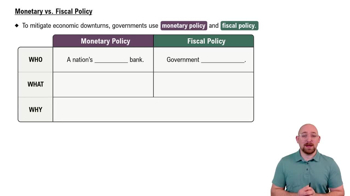
 03:13
03:13