Skip to main content
Microeconomics
My Course
Learn
Exam Prep
AI Tutor
Study Guides
Flashcards
Explore
Try the app
My Course
Learn
Exam Prep
AI Tutor
Study Guides
Flashcards
Explore
Try the app
Back
Market for Loanable Funds quiz
You can tap to flip the card.
What is the market for loanable funds?
You can tap to flip the card.
👆
What is the market for loanable funds?
It is the market where household savings are supplied to investors who demand funds for investment.
Track progress
Control buttons has been changed to "navigation" mode.
1/15
Related flashcards
Recommended videos
Market for Loanable Funds definitions
Market for Loanable Funds
15 Terms
04:42
Market for Loanable Funds
1
views
Terms in this set (15)
Hide definitions
What is the market for loanable funds?
It is the market where household savings are supplied to investors who demand funds for investment.
Who supplies funds in the market for loanable funds?
Households supply funds through their savings.
Who demands funds in the market for loanable funds?
Investors, including households and firms, demand funds for investment.
What acts as the 'price' in the market for loanable funds?
The interest rate acts as the price of borrowing funds.
How does a high interest rate affect the supply of loanable funds?
A high interest rate increases the supply of loanable funds as households are more willing to lend.
How does a high interest rate affect the demand for loanable funds?
A high interest rate decreases the demand for loanable funds because borrowing becomes more expensive.
What happens to demand for loanable funds when interest rates are low?
Demand for loanable funds increases because borrowing is cheaper.
What happens to supply of loanable funds when interest rates are low?
Supply decreases as households are less motivated to lend at low interest rates.
What is the equilibrium interest rate in the market for loanable funds?
It is the interest rate at which the quantity of funds supplied equals the quantity demanded.
How do banks participate in the market for loanable funds?
Banks lend out the savings deposited by households to investors.
Why are firms more likely to use the market for loanable funds than households?
Firms borrow larger amounts for investments like building warehouses or buying fleets, while households borrow for smaller purchases.
What does the x-axis represent in the loanable funds graph?
The x-axis represents the quantity of loanable funds.
What does the y-axis represent in the loanable funds graph?
The y-axis represents the interest rate.
What are the labels for supply and demand in the loanable funds graph?
Supply is labeled as LS (loanable supply) and demand as LD (loanable demand).
What is the opportunity cost for households lending their savings?
The opportunity cost is the interest rate they could earn by lending their savings instead of spending them.
 BackBack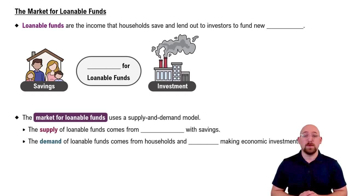
 04:42
04:42