Skip to main content
Microeconomics
My Course
Learn
Exam Prep
AI Tutor
Study Guides
Flashcards
Explore
Try the app
My Course
Learn
Exam Prep
AI Tutor
Study Guides
Flashcards
Explore
Try the app
Back
Market for Loanable Funds definitions
You can tap to flip the card.
Loanable Funds
You can tap to flip the card.
👆
Loanable Funds
Income saved by households and made available for investors to borrow, forming a pool that fuels new investments.
Track progress
Control buttons has been changed to "navigation" mode.
1/15
Related flashcards
Recommended videos
Market for Loanable Funds quiz
Market for Loanable Funds
15 Terms
04:42
Market for Loanable Funds
1
views
Terms in this set (15)
Hide definitions
Loanable Funds
Income saved by households and made available for investors to borrow, forming a pool that fuels new investments.
Household Savings
Money left over from income after spending, which is supplied to the market for loanable funds.
Investment
Use of borrowed funds by firms or households to purchase assets like vehicles, houses, or build infrastructure.
Interest Rate
Percentage charged on borrowed funds, acting as the cost of borrowing and influencing supply and demand.
Supply
Amount of loanable funds provided by households, increasing with higher interest rates.
Demand
Amount of loanable funds sought by investors, decreasing as interest rates rise.
Equilibrium
Point where supply and demand for loanable funds meet, setting the interest rate and quantity exchanged.
Opportunity Cost
Potential benefit forgone when savings are lent out instead of used for other purposes.
Marginal Benefit
Additional gain received from investing borrowed funds, influenced by the interest rate.
Quantity of Loanable Funds
Total amount of funds available for borrowing or lending in the market, shown on the x-axis of the graph.
Investor
Individual or firm seeking to borrow funds for investment, contributing to demand in the market.
Firm
Business entity that borrows large amounts from the market for loanable funds to finance major investments.
Bank Account
Financial tool where household savings are stored and potentially lent out to investors by banks.
Price-Quantity Graph
Visual representation of the market, with interest rate as price and quantity of loanable funds as the x-axis.
Equilibrium Interest Rate
Rate at which the amount of funds supplied equals the amount demanded, balancing savings and investment.
 BackBack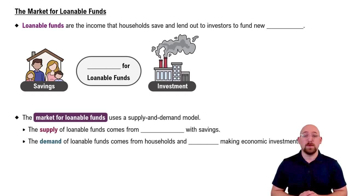
 04:42
04:42