Skip to main content
Microeconomics
My Course
Learn
Exam Prep
AI Tutor
Study Guides
Flashcards
Explore
Try the app
My Course
Learn
Exam Prep
AI Tutor
Study Guides
Flashcards
Explore
Try the app
Back
Long Run Effects of Fiscal Policy quiz
You can tap to flip the card.
What is a government budget deficit?
You can tap to flip the card.
👆
What is a government budget deficit?
A government budget deficit occurs when government spending exceeds its tax revenues.
Track progress
Control buttons has been changed to "navigation" mode.
1/15
Related flashcards
Recommended videos
Long Run Effects of Fiscal Policy definitions
Long Run Effects of Fiscal Policy
15 Terms
Guided course
02:40
Long Run Tax Policy
Guided course
03:39
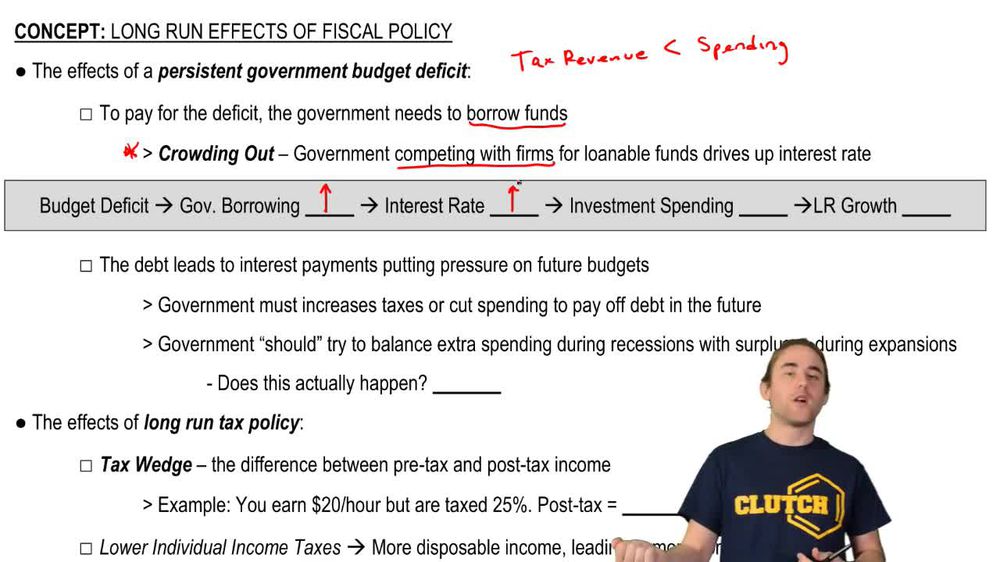
Persistent Budget Deficit
Terms in this set (15)
Hide definitions
What is a government budget deficit?
A government budget deficit occurs when government spending exceeds its tax revenues.
How does the government typically finance a budget deficit?
The government finances a budget deficit by borrowing funds, usually through issuing bonds.
What is the crowding out effect?
The crowding out effect is when increased government borrowing raises interest rates, reducing private investment spending.
Why do interest rates rise when the government borrows more?
Interest rates rise because the government competes with firms for loanable funds, increasing the demand for money.
How do higher interest rates affect investment spending?
Higher interest rates discourage investment spending because borrowing becomes more expensive for firms.
What is the long-run impact of reduced investment spending due to higher interest rates?
Reduced investment spending leads to stunted long-run economic growth, as fewer capital goods like factories and equipment are built.
How do persistent budget deficits affect future government budgets?
Persistent deficits increase debt and interest payments, putting pressure on future budgets and possibly requiring spending cuts or tax increases.
What fiscal policy is recommended during recessions and expansions?
It is recommended to increase government spending during recessions and run surpluses (spend less) during expansions.
Why is it difficult for governments to reduce spending after a recession?
It is difficult because once increased spending programs are in place, they are hard to reverse or cut back.
What is a tax wedge?
A tax wedge is the difference between pretax and post-tax income, representing the amount taken by taxes.
How do lower individual taxes affect disposable income and consumption?
Lower individual taxes increase disposable income, which leads to higher consumption.
How do lower corporate taxes influence investment?
Lower corporate taxes increase firms' returns, encouraging more investment.
How do lower taxes on savings affect the supply of loanable funds?
Lower taxes on savings increase the incentive to save, raising the supply of loanable funds.
What is the effect of an increased supply of loanable funds on interest rates?
An increased supply of loanable funds lowers interest rates.
Why is maintaining a balanced budget important in the long run?
A balanced budget is important to avoid future tax hikes or spending cuts and to maintain macroeconomic stability.
 BackBack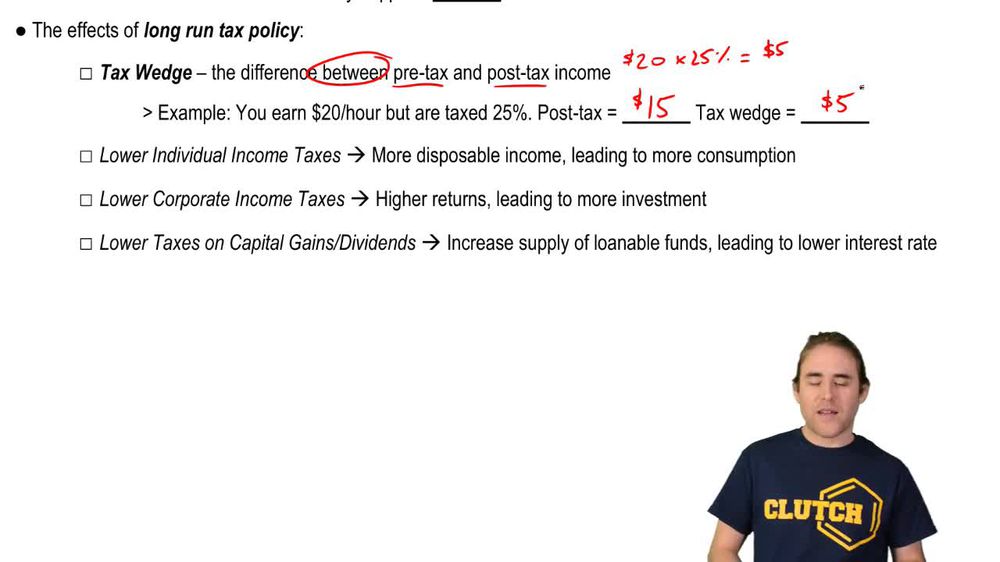
 02:40
02:40