Back

Indifference Curves for Perfect Substitutes and Perfect Complements quiz

Control buttons has been changed to "navigation" mode.
1/15
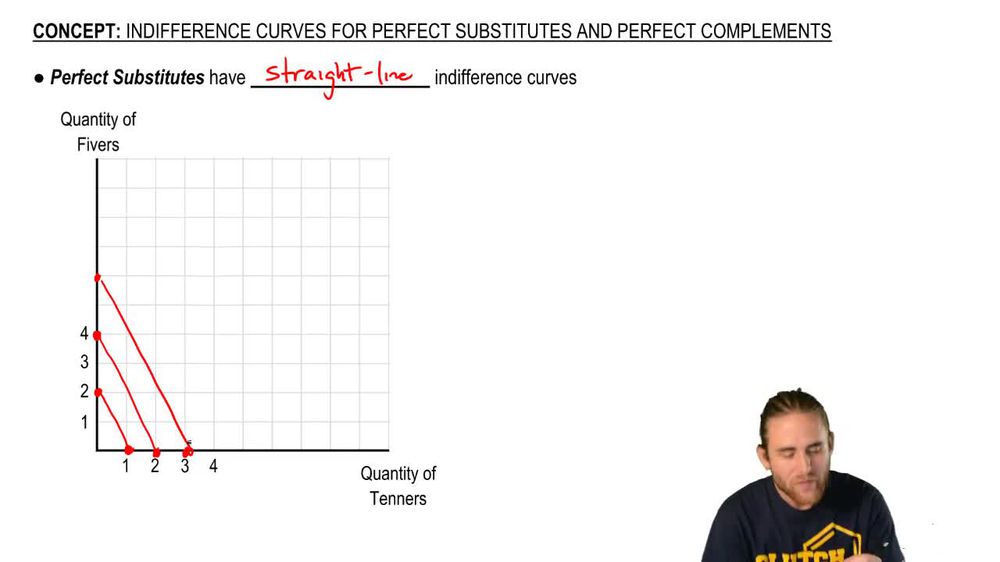
  • What shape do indifference curves for perfect substitutes take?

    Indifference curves for perfect substitutes are straight lines.
  • What is the marginal rate of substitution (MRS) for perfect substitutes?

    The MRS for perfect substitutes is constant.
  • Give an example of perfect substitutes discussed in the lesson.

    An example is \$5 bills and \$10 bills, where 2 \$5 bills are equivalent to 1 \$10 bill.
  • How does the MRS relate to \$5 bills and \$10 bills as perfect substitutes?

    The MRS is 2, meaning you would trade 2 \$5 bills for 1 \$10 bill.
  • What shape do indifference curves for perfect complements take?

    Indifference curves for perfect complements are right-angled.
  • Why are indifference curves for perfect complements right-angled?

    Because utility only increases when both goods are increased together in equal amounts.
  • Give an example of perfect complements discussed in the lesson.

    Left shoes and right shoes are perfect complements; you need equal amounts of each.
  • What happens to utility if you have more of one complement but not the other?

    Utility does not increase if you have more of one good without an equal increase in the other.
  • How does indifference work with left and right shoes as complements?

    You are indifferent between having extra left or right shoes as long as the matching quantity is fixed.
  • What is the ideal situation for perfect complements like shoes?

    The ideal is having equal numbers of left and right shoes, such as 2 left and 2 right.
  • How do indifference curves for perfect substitutes differ from those for perfect complements?

    Perfect substitutes have straight line indifference curves, while perfect complements have right-angled curves.
  • Why are perfect substitutes and complements considered 'silly' in the real world?

    Because such perfect relationships rarely exist in real-world goods.
  • What does the straight line of perfect substitutes indicate about substitution?

    It indicates a consistent rate at which one good can be substituted for another.
  • What does the right angle of perfect complements indicate about consumption?

    It shows that additional units of one good do not increase satisfaction unless matched by the other.
  • How do indifference curves change as you increase pairs of perfect complements?

    Each new pair creates a new right-angled indifference curve, reflecting the need for equal amounts.