Back

Indifference Curves for Perfect Substitutes and Perfect Complements definitions

Control buttons has been changed to "navigation" mode.
1/15
  • Indifference Curve

    Graphical representation showing combinations of goods yielding equal satisfaction to a consumer.
  • Perfect Substitute

    Item that can be exchanged for another at a fixed rate, providing identical satisfaction regardless of which is chosen.
  • Perfect Complement

    Item that must be paired in equal quantities with another to maximize satisfaction; excess of one does not increase utility.
  • Marginal Rate of Substitution

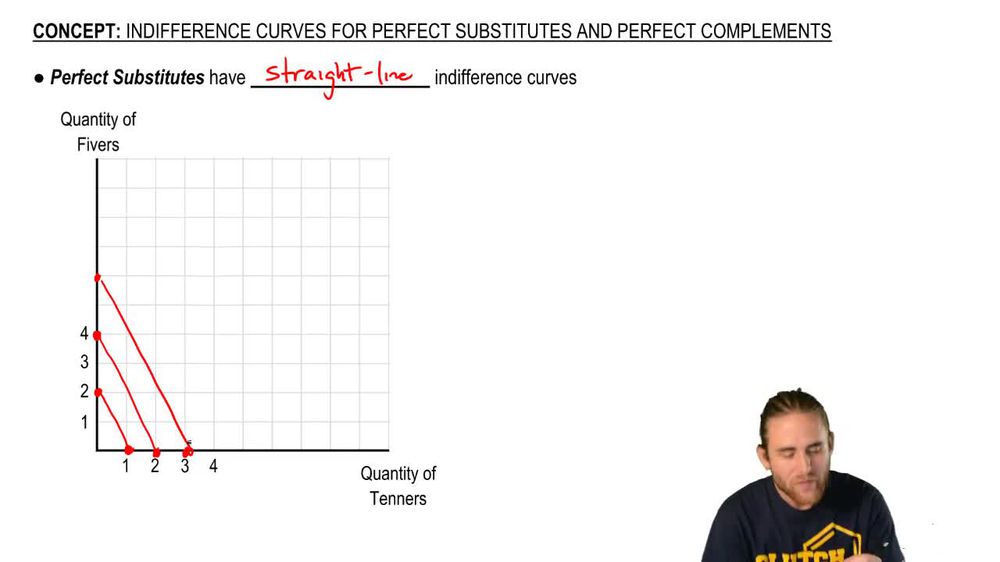
    Constant ratio at which one good can replace another along a straight indifference curve without changing satisfaction.
  • Straight Line

    Shape of indifference curve for perfect substitutes, reflecting a constant trade-off between goods.
  • Right Angle

    Shape of indifference curve for perfect complements, indicating utility depends on matching quantities.
  • Utility

    Level of satisfaction or benefit a consumer derives from consuming goods in specific combinations.
  • Pair Matching

    Requirement for equal quantities of two goods to achieve optimal satisfaction, as seen with complements.
  • Excess Quantity

    Situation where having more of one good does not increase satisfaction unless matched by the other in a complement pair.
  • Constant Ratio

    Fixed proportion at which goods are exchanged in perfect substitutes, such as 2:1 for \$5 and \$10 bills.
  • Satisfaction

    Consumer's perceived benefit from a combination of goods, remaining unchanged along an indifference curve.
  • Combination

    Specific mix of two goods that provides a certain level of utility to the consumer.
  • Optimal Use

    Situation where goods are consumed in proportions that maximize utility, especially relevant for complements.
  • Trade-Off

    Exchange of one good for another along an indifference curve, maintaining the same level of satisfaction.
  • Quantity Matching

    Condition where equal amounts of two goods are required for maximum utility, characteristic of perfect complements.