Skip to main content
Microeconomics
My Course
Learn
Exam Prep
AI Tutor
Study Guides
Flashcards
Explore
Try the app
My Course
Learn
Exam Prep
AI Tutor
Study Guides
Flashcards
Explore
Try the app
Back
History of the US Banking System quiz
You can tap to flip the card.
What was the main characteristic of the US banking system before 1864?
You can tap to flip the card.
👆
What was the main characteristic of the US banking system before 1864?
Banks printed their own notes, there was no uniform currency, and virtually no regulation.
Track progress
Control buttons has been changed to "navigation" mode.
1/15
Related flashcards
Recommended videos
History of the US Banking System definitions
History of the US Banking System
15 Terms
Guided course
09:10
History of the US Banking System
Terms in this set (15)
Hide definitions
What was the main characteristic of the US banking system before 1864?
Banks printed their own notes, there was no uniform currency, and virtually no regulation.
What major change occurred in the US banking system after 1864?
The federal government began regulating national banks and established a uniform currency, but there was still no central bank.
Why were bank panics and financial crises common between 1864 and 1913?
There was no central bank to manage the money supply, so banks couldn't respond to local fluctuations, leading to frequent panics and crises.
What event in 1907 highlighted the need for a central bank in the US?
The Panic of 1907, caused by risky investments by trusts and resulting in widespread bank runs, showed the need for a central bank.
Who played a key role in stabilizing the US economy during the Panic of 1907?
JP Morgan personally loaned reserves to banks to stop the panic and stabilize the economy.
What institution was created in response to the Panic of 1907?
The Federal Reserve, the US central bank, was created to control the money supply and prevent future panics.
What was a major cause of the Great Depression related to banking?
Plunging commodity prices led to bank runs in the 1930s, deepening the recession.
What did the Glass-Steagall Act of 1933 establish?
It created the FDIC to insure bank deposits and separated commercial banks from investment banks.
What is the purpose of FDIC insurance?
FDIC insurance protects bank deposits up to a certain amount, currently about \$250,000, to prevent bank runs.
How did the Glass-Steagall Act affect commercial and investment banks?
It separated them, with commercial banks being FDIC insured and investment banks not insured due to riskier investments.
What type of banks were at the center of the savings and loan crisis in the 1980s?
Savings and loan banks, which primarily took deposits and made home mortgages, were central to the crisis.
What led to the savings and loan crisis in the 1980s?
Deregulation allowed savings and loan banks to make riskier investments, leading to failures and a costly government bailout.
How much did the government spend to bail out savings and loan banks during the 1980s crisis?
The government, and thus taxpayers, paid approximately \$124 billion to bail out these banks.
What recurring theme is seen in US banking history regarding regulation?
When regulation is lacking, banks tend to take excessive risks, often leading to crises.
Why is understanding the history of the US banking system important for economics students?
It clarifies concepts like market power, economic profits, and the role of government intervention in stabilizing markets.
 BackBack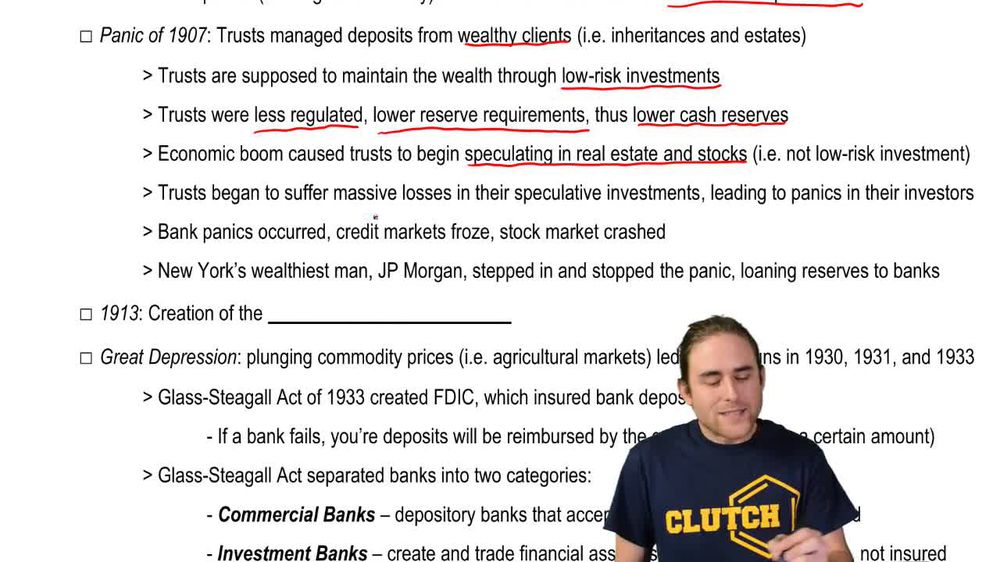
 09:10
09:10