Skip to main content
Microeconomics
My Course
Learn
Exam Prep
AI Tutor
Study Guides
Flashcards
Explore
Try the app
My Course
Learn
Exam Prep
AI Tutor
Study Guides
Flashcards
Explore
Try the app
Back
History of the US Banking System definitions
You can tap to flip the card.
Federal Reserve
You can tap to flip the card.
👆
Federal Reserve
Central institution established in 1913 to manage the US money supply and respond to financial crises, providing stability to the banking system.
Track progress
Control buttons has been changed to "navigation" mode.
1/15
Related flashcards
Recommended videos
History of the US Banking System quiz
History of the US Banking System
15 Terms
Guided course
09:10
History of the US Banking System
Terms in this set (15)
Hide definitions
Federal Reserve
Central institution established in 1913 to manage the US money supply and respond to financial crises, providing stability to the banking system.
Bank Panic
Event where depositors rush to withdraw funds, fearing insolvency, often leading to frozen assets and widespread financial instability.
Bank Run
Situation in which a large number of customers withdraw deposits simultaneously, causing liquidity shortages and potential bank failure.
Glass-Steagall Act
1933 legislation that separated commercial and investment banking, aiming to reduce risk and protect consumer deposits.
FDIC Insurance
Government-backed guarantee that reimburses depositors up to a set limit if their bank fails, promoting confidence in the banking system.
Commercial Bank
Institution offering deposit accounts and loans, typically insured by the government to safeguard customer funds.
Investment Bank
Financial entity specializing in creating and trading assets like stocks and bonds, operating without deposit insurance.
Savings and Loan Crisis
1980s event where deregulation and risky investments led to widespread failures and costly government bailouts.
Money Supply
Total amount of currency and liquid assets available in the economy, managed by central authorities to influence economic conditions.
Trust
Organization managing assets for wealthy clients, often with less regulation and lower reserve requirements than traditional banks.
Uniform Currency
Standardized monetary system introduced post-1864, replacing bank-specific notes to facilitate national economic transactions.
Reserve Requirement
Regulatory mandate determining the minimum funds banks must hold, affecting their ability to lend and withstand withdrawals.
Deposit
Funds placed in a financial institution for safekeeping, which may be insured or subject to risk depending on the bank type.
Financial Crisis
Period of severe economic disruption marked by widespread bank failures, frozen credit markets, and loss of public confidence.
Inflation
Sustained increase in general price levels, often impacting banking stability and prompting shifts in depositor behavior.
 BackBack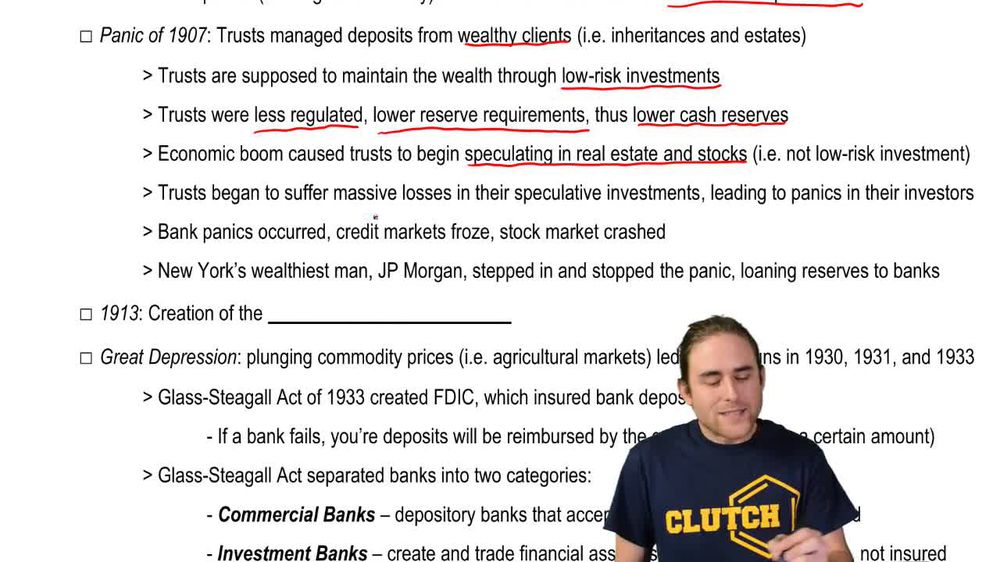
 09:10
09:10