Skip to main content
Microeconomics
My Course
Learn
Exam Prep
AI Tutor
Study Guides
Flashcards
Explore
Try the app
My Course
Learn
Exam Prep
AI Tutor
Study Guides
Flashcards
Explore
Try the app
Back
Federal Reserve Policies during the 2007-2009 Recession quiz
You can tap to flip the card.
What was the main financial instrument at the center of the 2007-2009 recession?
You can tap to flip the card.
👆
What was the main financial instrument at the center of the 2007-2009 recession?
Mortgage-backed securities (MBS) were at the center, as they bundled both low and high-risk mortgages and were widely held by investment banks.
Track progress
Control buttons has been changed to "navigation" mode.
1/15
Related flashcards
Recommended videos
Federal Reserve Policies during the 2007-2009 Recession definitions
Federal Reserve Policies during the 2007-2009 Recession
15 Terms
Guided course
08:06
Federal Reserve Policies during the 2007-2009 Recession
1
views
Terms in this set (15)
Hide definitions
What was the main financial instrument at the center of the 2007-2009 recession?
Mortgage-backed securities (MBS) were at the center, as they bundled both low and high-risk mortgages and were widely held by investment banks.
Why did investment banks suffer huge losses during the 2008 recession?
They held large positions in mortgage-backed securities, which lost value as more homeowners defaulted on their mortgages.
What unprecedented action did the Federal Reserve take regarding discount loans during the recession?
The Fed allowed investment banks, not just commercial banks, to access discount loans to provide them with liquidity.
How did the Fed use Treasury securities to help banks during the crisis?
The Fed loaned \$200 billion in Treasury securities to banks in exchange for mortgage-backed securities, giving banks more liquid collateral.
What was the purpose of the Fed assisting JPMorgan Chase in acquiring Bear Stearns?
The Fed aimed to prevent a financial panic and a domino effect that could worsen the recession by facilitating the acquisition.
Why did the government take control of Fannie Mae and Freddie Mac in September 2008?
To maintain confidence in mortgage-backed securities and prevent a deeper recession if these major mortgage companies failed.
What is 'moral hazard' in the context of the 2008 financial crisis?
Moral hazard refers to the risk that banks will take excessive risks, expecting government bailouts if things go wrong.
Why did the Fed allow Lehman Brothers to fail?
To avoid encouraging moral hazard by not always bailing out failing investment banks, which could promote risky behavior.
What was the Troubled Asset Relief Program (TARP)?
TARP was a program where the federal government injected funds into commercial banks in exchange for partial ownership.
Why was TARP considered unprecedented?
Because the federal government took ownership stakes in private investment banks, which was not typical policy.
How did the Fed’s actions during the Great Recession differ from previous recessions?
The Fed implemented unprecedented measures, such as lending to investment banks and taking ownership stakes in private banks.
What role did liquidity play in the Fed’s response to the crisis?
The Fed provided liquidity to banks to prevent insolvency and stabilize the financial system.
How did the Fed’s interventions help prevent a deeper recession?
By stabilizing banks and maintaining market confidence, the interventions mitigated economic losses and prevented further collapse.
What is the significance of market equilibrium in the context of the Fed’s crisis response?
Maintaining market equilibrium was crucial to prevent panic and restore normal functioning in financial markets.
How did the Fed’s policies address externalities during the financial crisis?
The policies aimed to manage negative externalities, such as widespread bank failures, that could harm the broader economy.
 BackBack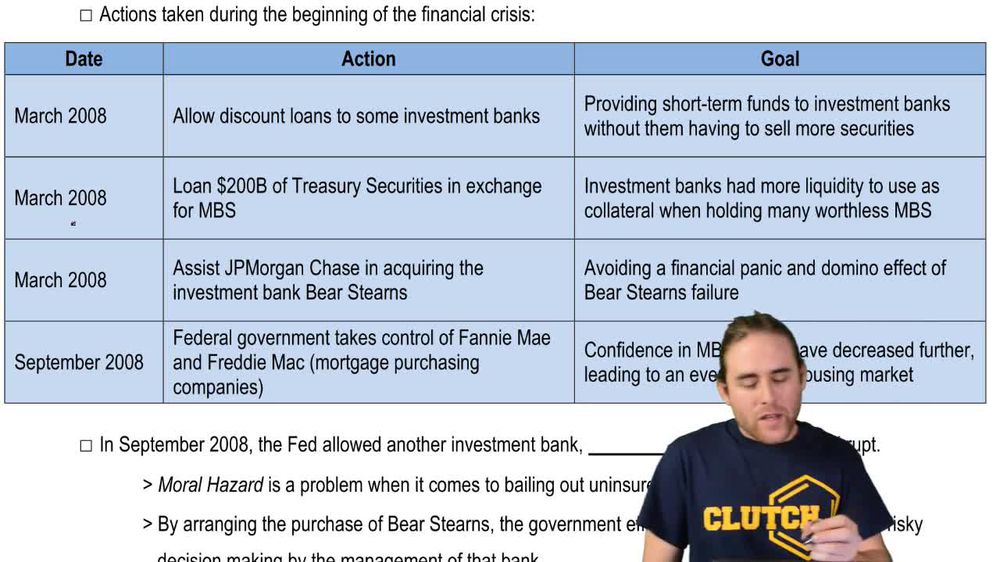
 08:06
08:06