Skip to main content
Microeconomics
My Course
Learn
Exam Prep
AI Tutor
Study Guides
Flashcards
Explore
Try the app
My Course
Learn
Exam Prep
AI Tutor
Study Guides
Flashcards
Explore
Try the app
Back
Federal Reserve Policies during the 2007-2009 Recession definitions
You can tap to flip the card.
Monetary Policy
You can tap to flip the card.
👆
Monetary Policy
Actions by a central bank to influence money supply and interest rates, often used to stabilize financial systems during crises.
Track progress
Control buttons has been changed to "navigation" mode.
1/15
Related flashcards
Recommended videos
Federal Reserve Policies during the 2007-2009 Recession quiz
Federal Reserve Policies during the 2007-2009 Recession
15 Terms
Guided course
08:06
Federal Reserve Policies during the 2007-2009 Recession
1
views
Terms in this set (15)
Hide definitions
Monetary Policy
Actions by a central bank to influence money supply and interest rates, often used to stabilize financial systems during crises.
Mortgage-Backed Securities
Financial instruments created by bundling home loans, offering returns based on mortgage payments but carrying risk if borrowers default.
Liquidity
Availability of cash or easily convertible assets, crucial for banks to meet obligations and prevent insolvency during financial turmoil.
Discount Loans
Low-interest, short-term funds provided by a central bank, typically to commercial banks but extended to investment banks in emergencies.
Investment Banks
Financial institutions specializing in securities trading and underwriting, heavily exposed to mortgage-backed securities during the recession.
Treasury Securities
Government-issued debt instruments considered safe, used as collateral to enhance bank liquidity during the financial crisis.
Bear Stearns
Major investment bank whose near-collapse prompted government intervention to prevent wider financial panic.
JPMorgan Chase
Investment bank that acquired Bear Stearns with government assistance, helping to stabilize the financial sector.
Fannie Mae
Government-sponsored enterprise involved in purchasing mortgages, taken over to maintain confidence in mortgage markets.
Freddie Mac
Public entity supporting mortgage markets, whose government takeover aimed to prevent further erosion of market stability.
Lehman Brothers
Investment bank allowed to fail during the recession, illustrating the risks of moral hazard in government bailouts.
Moral Hazard
Situation where entities take excessive risks, expecting government rescue, potentially encouraging future reckless behavior.
Troubled Asset Relief Program
Federal initiative injecting capital into banks in exchange for ownership stakes, designed to prevent deeper economic losses.
Market Equilibrium
State where supply and demand balance, disrupted during the recession by failing financial institutions and asset devaluation.
Externalities
Unintended side effects of economic actions, such as widespread financial instability impacting the broader economy.
 BackBack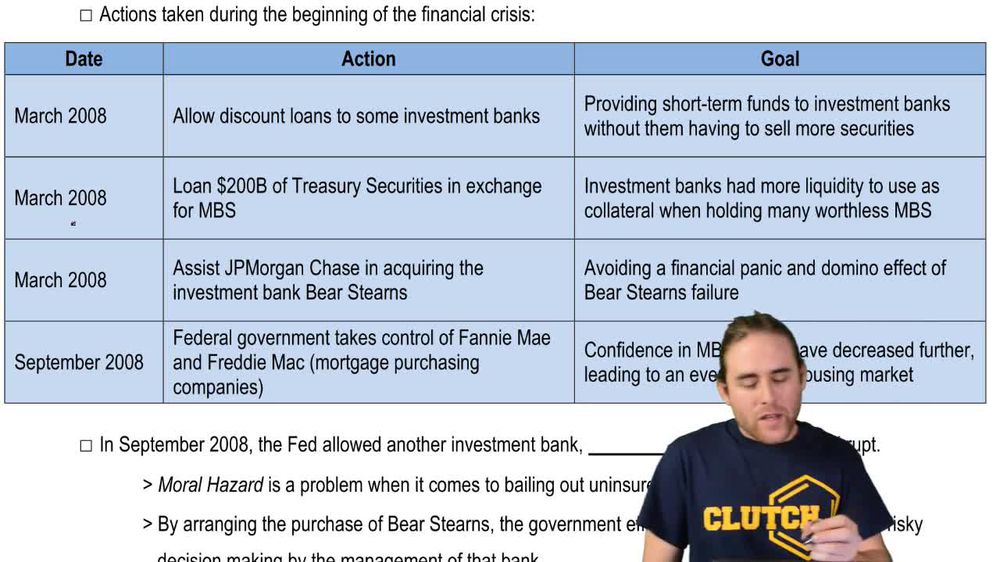
 08:06
08:06