Skip to main content
Microeconomics
My Course
Learn
Exam Prep
AI Tutor
Study Guides
Flashcards
Explore
Try the app
My Course
Learn
Exam Prep
AI Tutor
Study Guides
Flashcards
Explore
Try the app
Back
Expenditure Approach for Measuring GDP quiz
You can tap to flip the card.
What does GDP stand for and what does it measure?
You can tap to flip the card.
👆
What does GDP stand for and what does it measure?
GDP stands for Gross Domestic Product and it measures the total value of all final goods and services produced within a country in a year.
Track progress
Control buttons has been changed to "navigation" mode.
1/15
Related flashcards
Recommended videos
Expenditure Approach for Measuring GDP definitions
Expenditure Approach for Measuring GDP
14 Terms
02:31
Calculating GDP Using the Expenditure Approach
Terms in this set (15)
Hide definitions
What does GDP stand for and what does it measure?
GDP stands for Gross Domestic Product and it measures the total value of all final goods and services produced within a country in a year.
What does the term 'gross' mean in GDP?
'Gross' means total or aggregate, not something negative.
Why does GDP only include final goods and services?
GDP includes only final goods and services to avoid double counting and accurately reflect total production.
Does GDP measure goods that are sold or produced?
GDP measures goods and services that are produced, regardless of whether they are sold.
What is the most common method for calculating GDP?
The most common method is the expenditure approach.
What is the formula for the expenditure approach to GDP?
The formula is GDP = C + I + G + NX.
What does 'C' represent in the GDP expenditure formula?
'C' stands for consumption, which is household spending on goods and services.
What does 'I' represent in the GDP expenditure formula?
'I' stands for investment, specifically capital investment in things like equipment, buildings, and inventory.
What does 'G' represent in the GDP expenditure formula?
'G' stands for government spending on goods and services.
What does 'NX' represent in the GDP expenditure formula?
'NX' stands for net exports, which is exports minus imports.
Can net exports (NX) be a negative number in the GDP formula?
Yes, net exports can be negative if imports exceed exports.
Why are intermediate goods excluded from GDP calculations?
Intermediate goods are excluded to prevent double counting since their value is already included in final goods.
How often is GDP typically measured?
GDP is usually measured on a yearly basis.
What type of investment is included in the 'I' component of GDP?
Only physical or capital investment, such as equipment and buildings, is included—not financial investments like stocks or bonds.
Why is understanding GDP important for economists?
Understanding GDP helps analyze market equilibrium, economic growth, and overall macroeconomic performance.
 BackBack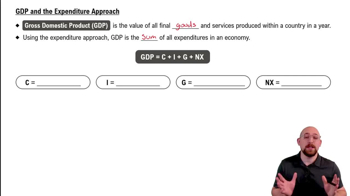
 02:31
02:31