Skip to main content
Microeconomics
My Course
Learn
Exam Prep
AI Tutor
Study Guides
Flashcards
Explore
Try the app
My Course
Learn
Exam Prep
AI Tutor
Study Guides
Flashcards
Explore
Try the app
Back
Expenditure Approach for Measuring GDP definitions
You can tap to flip the card.
Gross Domestic Product
You can tap to flip the card.
👆
Gross Domestic Product
Total value of all final goods and services produced within a country during a year, reflecting economic productivity.
Track progress
Control buttons has been changed to "navigation" mode.
1/14
Related flashcards
Recommended videos
Expenditure Approach for Measuring GDP quiz
Expenditure Approach for Measuring GDP
15 Terms
02:31
Calculating GDP Using the Expenditure Approach
Terms in this set (14)
Hide definitions
Gross Domestic Product
Total value of all final goods and services produced within a country during a year, reflecting economic productivity.
Final Goods
Products that have completed production and are ready for consumption, not used as inputs for further manufacturing.
Expenditure Approach
Method for calculating economic output by summing all spending categories: households, capital, government, and net exports.
Consumption
Household spending on goods and services, such as groceries or car washes, representing a major component of economic activity.
Investment
Capital spending on inventory, equipment, or buildings, excluding financial assets like stocks or bonds.
Government Spending
Public sector purchases of goods and services, contributing to national economic output.
Net Exports
Difference between a country's exports and imports, which can be positive or negative in GDP calculation.
Exports
Goods and services produced domestically and sold to other countries, increasing national output.
Imports
Goods and services purchased from abroad, subtracted from national output in GDP calculations.
Capital Investment
Physical assets acquired for production, such as machinery or buildings, enhancing productive capacity.
Economic Productivity
Measure of how efficiently resources are used to produce goods and services within a country.
Market Equilibrium
State where total supply and demand in an economy are balanced, often analyzed using GDP data.
Economic Growth
Increase in a country's output of goods and services over time, often tracked by changes in GDP.
Macroeconomic Performance
Overall health and stability of a nation's economy, assessed using indicators like GDP.
 BackBack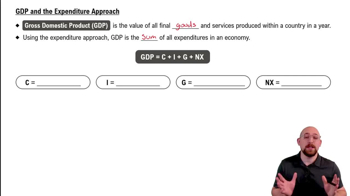
 02:31
02:31