Skip to main content
Microeconomics
My Course
Learn
Exam Prep
AI Tutor
Study Guides
Flashcards
Explore
Try the app
My Course
Learn
Exam Prep
AI Tutor
Study Guides
Flashcards
Explore
Try the app
Back
Expansionary and Contractionary Monetary Policy quiz
You can tap to flip the card.
What are the two main goals of the Federal Reserve when conducting monetary policy?
You can tap to flip the card.
👆
What are the two main goals of the Federal Reserve when conducting monetary policy?
The Fed aims to manage employment and maintain price stability in the economy.
Track progress
Control buttons has been changed to "navigation" mode.
1/15
Related flashcards
Recommended videos
Expansionary and Contractionary Monetary Policy definitions
Expansionary and Contractionary Monetary Policy
15 Terms
Guided course
07:42
Expansionary Monetary Policy
Guided course
08:07
Contractionary Monetary Policy
Terms in this set (15)
Hide definitions
What are the two main goals of the Federal Reserve when conducting monetary policy?
The Fed aims to manage employment and maintain price stability in the economy.
What is expansionary monetary policy designed to do during a recession?
It increases the money supply, lowers interest rates, and shifts aggregate demand right to boost GDP.
How does the Fed lower interest rates in the money market?
The Fed increases the money supply, which leads to a lower equilibrium interest rate.
What open market operation does the Fed use to increase the money supply?
The Fed purchases treasury securities from the public to inject money into the economy.
How does a lower interest rate affect investment, consumption, and net exports?
Lower interest rates increase investment, consumption, and net exports, raising aggregate demand.
What happens to the aggregate demand curve when the Fed employs expansionary monetary policy?
The aggregate demand curve shifts to the right, increasing GDP and price level.
What is the result of expansionary monetary policy on the AD-AS model?
It moves the economy from a recessionary short-run equilibrium to a long-run equilibrium with higher GDP and price level.
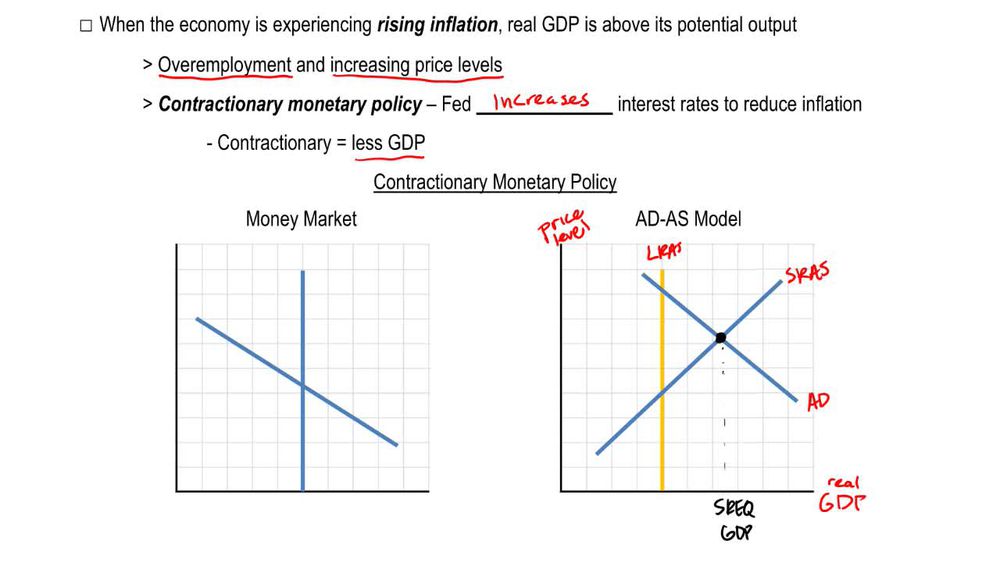
When does the Fed use contractionary monetary policy?
The Fed uses contractionary policy when the economy is experiencing high inflation and overemployment.
What is the main goal of contractionary monetary policy?
Its goal is to decrease GDP and reduce inflation by raising interest rates.
How does the Fed raise interest rates in the money market?
The Fed decreases the money supply, which leads to a higher equilibrium interest rate.
What open market operation does the Fed use to decrease the money supply?
The Fed sells treasury securities to the public, taking money out of circulation.
How does a higher interest rate affect investment, consumption, and net exports?
Higher interest rates decrease investment, consumption, and net exports, lowering aggregate demand.
What happens to the aggregate demand curve when the Fed employs contractionary monetary policy?
The aggregate demand curve shifts to the left, reducing GDP and price level.
What is the result of contractionary monetary policy on the AD-AS model?
It moves the economy from an overheated short-run equilibrium to a sustainable long-run equilibrium with lower price level.
How do monetary policy actions by the Fed affect the AD-AS model?
By changing the money supply and interest rates, the Fed shifts aggregate demand, influencing GDP and price levels.
 BackBack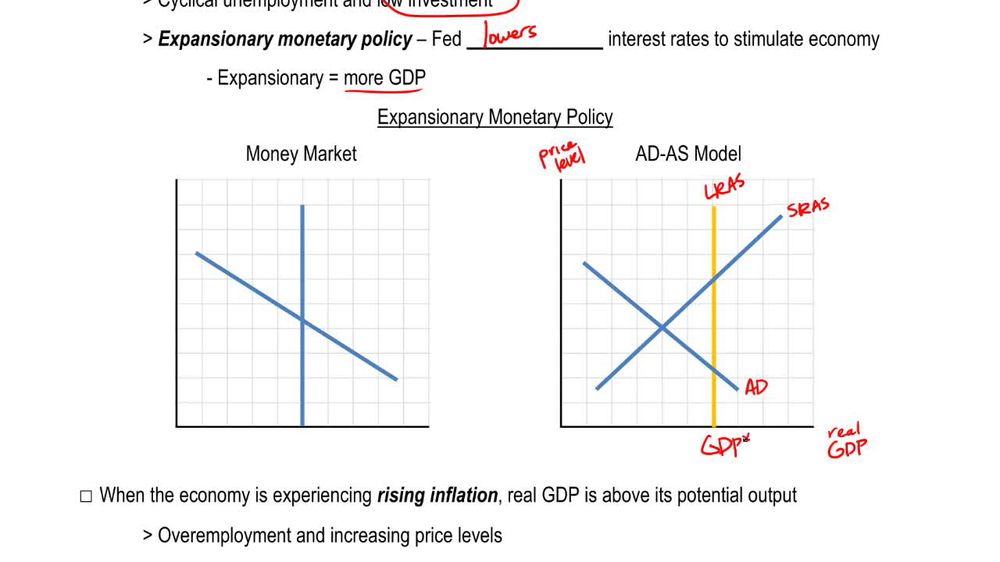
 07:42
07:42