Skip to main content
Microeconomics
My Course
Learn
Exam Prep
AI Tutor
Study Guides
Flashcards
Explore
Try the app
My Course
Learn
Exam Prep
AI Tutor
Study Guides
Flashcards
Explore
Try the app
Back
Expansionary and Contractionary Monetary Policy definitions
You can tap to flip the card.
Federal Reserve
You can tap to flip the card.
👆
Federal Reserve
Central authority responsible for managing employment and price stability through monetary policy actions.
Track progress
Control buttons has been changed to "navigation" mode.
1/15
Related flashcards
Recommended videos
Expansionary and Contractionary Monetary Policy quiz
Expansionary and Contractionary Monetary Policy
15 Terms
Guided course
07:42
Expansionary Monetary Policy
Guided course
08:07
Contractionary Monetary Policy
Terms in this set (15)
Hide definitions
Federal Reserve
Central authority responsible for managing employment and price stability through monetary policy actions.
Monetary Policy
Strategy for influencing economic activity by adjusting money supply and interest rates to achieve macroeconomic goals.
Money Supply
Total amount of currency and liquid assets available in the economy, controlled by central bank operations.
Interest Rate
Cost of borrowing money, determined in the money market and targeted by central bank to influence spending.
Aggregate Demand
Total spending on goods and services in an economy, affected by investment, consumption, and net exports.
Aggregate Supply
Total output of goods and services produced in an economy, represented in both short and long run models.
ADAS Model
Framework combining aggregate demand and aggregate supply to analyze price levels and real GDP equilibrium.
Expansionary Policy
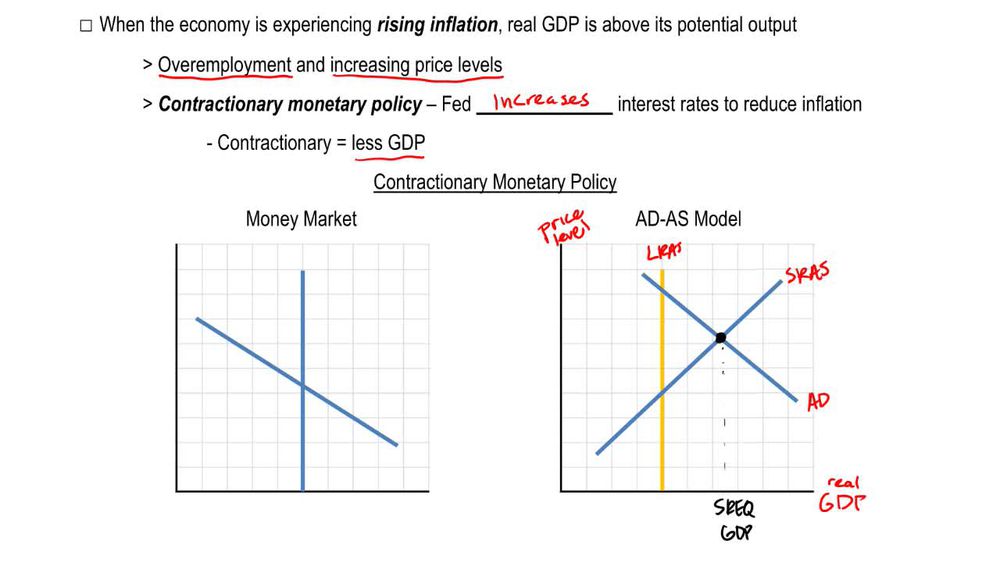
Approach that increases money supply and lowers interest rates to stimulate investment and boost GDP during recessions.
Contractionary Policy
Approach that decreases money supply and raises interest rates to reduce inflation and stabilize GDP during overheated periods.
Open Market Operation
Central bank activity of buying or selling securities to adjust money supply and influence interest rates.
Investment
Spending by firms on capital goods, sensitive to interest rate changes and a key component of aggregate demand.
Consumption
Household spending on goods and services, influenced by interest rates and monetary policy actions.
Net Exports
Difference between exports and imports, affected by domestic interest rates and currency value.
Equilibrium
Point where supply and demand curves intersect, determining price level and real GDP in economic models.
Price Level
Average of current prices across the entire economy, influenced by shifts in aggregate demand and supply.
 BackBack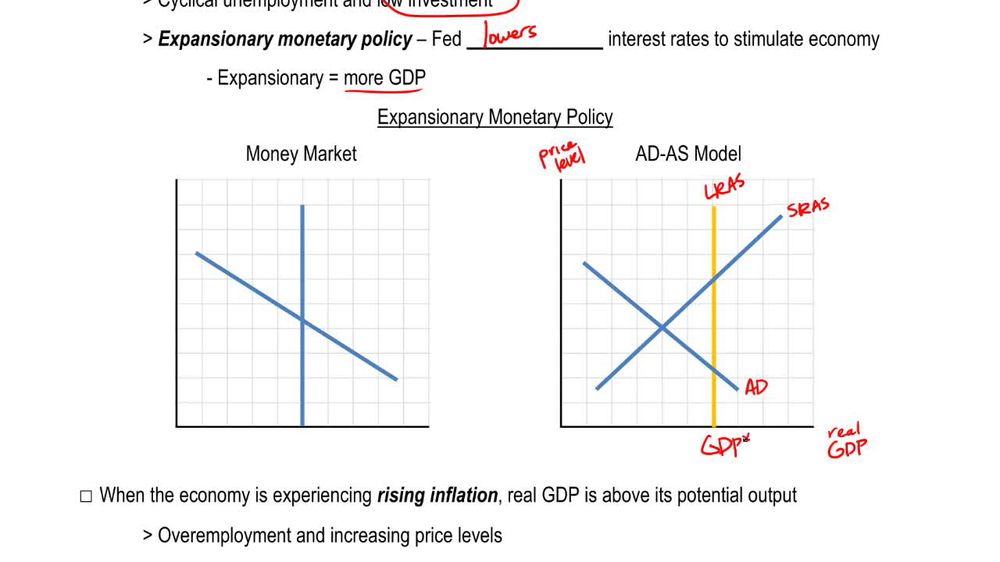
 07:42
07:42