What does purchasing power parity (PPP) mean in the context of exchange rates?
PPP means that exchange rates equalize the purchasing power of different currencies, so the same good costs the same in each country when converted at the exchange rate.
In the example given, what does it indicate if \$1 buys one loaf of bread in both the US and Japan?
It indicates that purchasing power parity holds because the exchange rate allows \$1 to buy the same amount of bread in both countries.
What happens to PPP if the exchange rate changes so that \$1 equals 300 yen, but bread still costs \$1 in the US and 150 yen in Japan?
PPP does not hold because \$1 can now buy two loaves of bread in Japan but only one in the US, so purchasing power is not equalized.
Why do exchange rates tend to adjust toward purchasing power parity?
Exchange rates adjust toward PPP because differences in purchasing power create incentives for currency and goods markets to move toward price equalization.
Name one reason why perfect purchasing power parity might not be achieved.
Perfect PPP might not be achieved because many goods are not traded internationally, so their prices are not influenced by exchange rates.
How do trade barriers affect purchasing power parity?
Trade barriers like tariffs or import restrictions prevent prices from equalizing across countries, thus preventing PPP.
Why might restaurant meals not achieve purchasing power parity between countries?
Restaurant meals are not traded internationally, so their prices are not influenced by exchange rates and can differ widely between countries.
How can differences in consumer preferences prevent PPP?
If preferences for a product are higher in one country, prices may be higher there, preventing PPP even if exchange rates adjust.
What is the effect of non-traded goods on PPP?
Non-traded goods are not subject to international competition, so their prices can differ across countries, preventing PPP.
If \$1 can buy more goods in one country than another after currency conversion, what does this say about PPP?
It means PPP does not hold because purchasing power is not equalized between the countries.
What role do supply and demand play in exchange rates and PPP?
Supply and demand for currencies influence exchange rates, which in turn affect whether PPP is achieved.
How does PPP help us analyze international trade?
PPP helps us understand how exchange rates and price differences influence trade flows and market equilibrium.
What is an example of a good that is unlikely to achieve PPP and why?
Restaurant meals are an example because they are not traded internationally, so their prices are not equalized by exchange rates.
What might happen to exchange rates if PPP does not hold for a widely traded good?
Exchange rates may adjust to reduce the price difference and move toward PPP for that good.
Why is it important to consider barriers to entry when analyzing PPP?
Barriers to entry like tariffs or regulations can prevent prices from equalizing, thus preventing PPP from being achieved.
 Back
Back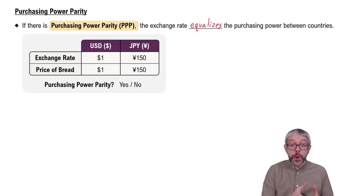
 03:53
03:53