Skip to main content
Microeconomics
My Course
Learn
Exam Prep
AI Tutor
Study Guides
Flashcards
Explore
Try the app
My Course
Learn
Exam Prep
AI Tutor
Study Guides
Flashcards
Explore
Try the app
Back
Exchange Rates: Purchasing Power Parity definitions
You can tap to flip the card.
Purchasing Power Parity
You can tap to flip the card.
👆
Purchasing Power Parity
A condition where currency exchange rates allow equal buying power for goods in different countries.
Track progress
Control buttons has been changed to "navigation" mode.
1/15
Related flashcards
Recommended videos
Exchange Rates: Purchasing Power Parity quiz
Exchange Rates: Purchasing Power Parity
15 Terms
03:53
Purchasing Power Parity
Terms in this set (15)
Hide definitions
Purchasing Power Parity
A condition where currency exchange rates allow equal buying power for goods in different countries.
Exchange Rate
The value at which one currency can be traded for another, affecting international purchasing power.
International Trade
The exchange of goods and services across national borders, influenced by currency values.
Non-Traded Goods
Products not exchanged internationally, such as local restaurant meals, unaffected by currency shifts.
Trade Barrier
Restrictions like tariffs or import limits that prevent price equalization between countries.
Tariff
A tax imposed on imported goods, raising their price and hindering purchasing power parity.
Import Restriction
A policy limiting the quantity or type of goods entering a country, disrupting price normalization.
Price Equalization
The process where prices for identical goods converge across countries due to currency adjustments.
Market Equilibrium
A state where supply and demand balance, often influenced by international price and currency changes.
Economic Profit
The surplus earned when revenues exceed costs, affected by global price differences and trade.
Supply
The total amount of a good available for sale, impacting exchange rates and international prices.
Demand
The desire for goods and services, shaping currency values and price levels across countries.
Preferences
Consumer tastes and choices that vary by country, influencing local prices and purchasing power.
Currency
A nation's monetary unit used for transactions, whose value determines international buying power.
Price Normalization
The tendency for prices to adjust and become similar across countries, barring trade barriers.
 BackBack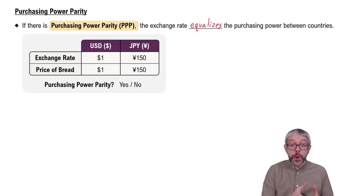
 03:53
03:53