Skip to main content
Microeconomics
My Course
Learn
Exam Prep
AI Tutor
Study Guides
Flashcards
Explore
Try the app
My Course
Learn
Exam Prep
AI Tutor
Study Guides
Flashcards
Explore
Try the app
Back
Exchange Rates: Equilibrium quiz
You can tap to flip the card.
What is the foreign exchange market?
You can tap to flip the card.
👆
What is the foreign exchange market?
It is a market where people acquire foreign currency from others who have it, including travelers, currency traders, and multinational corporations.
Track progress
Control buttons has been changed to "navigation" mode.
1/15
Related flashcards
Recommended videos
Exchange Rates: Equilibrium definitions
Exchange Rates: Equilibrium
15 Terms
03:41
Market for Foreign Exchange: Supply
04:19
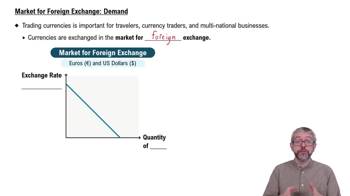
Market for Foreign Exchange: Demand
Terms in this set (15)
Hide definitions
What is the foreign exchange market?
It is a market where people acquire foreign currency from others who have it, including travelers, currency traders, and multinational corporations.
How is the price of a currency expressed in the foreign exchange market?
The price is expressed as an exchange rate, such as US dollars per euro, indicating how much of one currency is needed to buy another.
What happens to the demand for euros when the euro appreciates?
The demand for euros decreases because euros become more expensive, making fewer people interested in acquiring them.
Why is the demand curve for euros downward sloping?
As the exchange rate rises and euros become more expensive, the quantity demanded decreases, creating a downward sloping demand curve.
Who are the main participants in the foreign exchange market?
The main participants are travelers, currency traders, and multinational corporations.
What does appreciation of the euro mean in terms of exchange rate?
Appreciation means the euro can buy more foreign currency, so the exchange rate increases (e.g., from \$1.25 to \$1.50 per euro).
How does euro appreciation affect travelers and multinational corporations?
It may lead travelers to choose other destinations and corporations to buy products from countries with cheaper currencies.
What is measured on the x-axis in the market for euros diagram?
The x-axis measures the quantity of euros being bought and sold.
How does the supply curve for euros behave in the foreign exchange market?
The supply curve is upward sloping, meaning the quantity supplied increases as the exchange rate rises.
Why does the supply of euros increase when the euro appreciates?
Because people with euros can get more foreign currency for each euro, making them more willing to sell their euros.
Who typically supplies euros in the foreign exchange market?
People who live in Europe and have euros supply them to those who need the currency.
What determines the equilibrium exchange rate in the foreign exchange market?
The equilibrium exchange rate is where the quantity demanded and quantity supplied of a currency are balanced.
How is the equilibrium exchange rate found on a supply and demand diagram?
It is found at the intersection of the supply and demand curves for the currency.
What happens to the supply of euros when the exchange rate increases?
The supply of euros increases because sellers receive more foreign currency for each euro.
How does the foreign exchange market compare to other supply and demand markets?
It operates identically, with equilibrium determined by the intersection of supply and demand curves.
 BackBack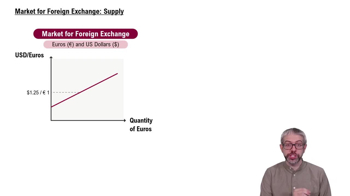
 03:41
03:41