Skip to main content
Microeconomics
My Course
Learn
Exam Prep
AI Tutor
Study Guides
Flashcards
Explore
Try the app
My Course
Learn
Exam Prep
AI Tutor
Study Guides
Flashcards
Explore
Try the app
Back
Exchange Rates: Equilibrium definitions
You can tap to flip the card.
Exchange Rate
You can tap to flip the card.
👆
Exchange Rate
Cost of acquiring one unit of a currency expressed in terms of another currency, such as US dollars per euro.
Track progress
Control buttons has been changed to "navigation" mode.
1/15
Related flashcards
Recommended videos
Exchange Rates: Equilibrium quiz
Exchange Rates: Equilibrium
15 Terms
03:41
Market for Foreign Exchange: Supply
04:19
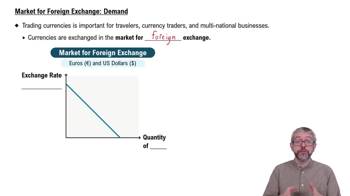
Market for Foreign Exchange: Demand
Terms in this set (15)
Hide definitions
Exchange Rate
Cost of acquiring one unit of a currency expressed in terms of another currency, such as US dollars per euro.
Foreign Exchange Market
Marketplace where individuals and entities trade currencies, determining their relative values.
Euro
European currency traded in foreign exchange markets, whose value fluctuates against other currencies.
Demand Curve
Graphical representation showing how the quantity of a currency desired changes as its price varies.
Supply Curve
Graph illustrating how the quantity of a currency offered for sale changes with its price.
Appreciation
Increase in a currency's value, allowing it to purchase more units of another currency.
Quantity Demanded
Amount of a currency buyers are willing to acquire at a specific exchange rate.
Quantity Supplied
Amount of a currency sellers are willing to offer at a particular exchange rate.
Market Equilibrium
Point where the quantity of currency demanded equals the quantity supplied, setting the prevailing exchange rate.
Downward Sloping
Shape of the demand curve indicating that higher prices lead to lower quantities desired.
Upward Sloping
Shape of the supply curve showing that higher prices result in greater quantities offered.
Currency Trader
Participant in the foreign exchange market seeking profit from fluctuations in currency values.
Multinational Corporation
Business operating in multiple countries, requiring foreign currency for international transactions.
Traveler
Individual needing foreign currency to purchase goods and services abroad.
Elasticity
Measure of how sensitive the quantity demanded or supplied of a currency is to changes in its exchange rate.
 BackBack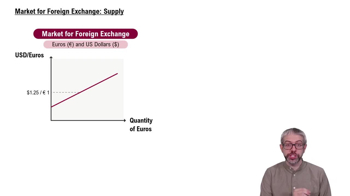
 03:41
03:41