Skip to main content
Microeconomics
My Course
Learn
Exam Prep
AI Tutor
Study Guides
Flashcards
Explore
Try the app
My Course
Learn
Exam Prep
AI Tutor
Study Guides
Flashcards
Explore
Try the app
Back
Dynamic AD-AS Model: Fiscal Policy quiz
You can tap to flip the card.
What is the main goal of fiscal policy in the dynamic AD-AS model?
You can tap to flip the card.
👆
What is the main goal of fiscal policy in the dynamic AD-AS model?
The main goal is to adjust aggregate demand to maintain potential GDP and achieve long-run equilibrium.
Track progress
Control buttons has been changed to "navigation" mode.
1/15
Related flashcards
Recommended videos
Dynamic AD-AS Model: Fiscal Policy definitions
Dynamic AD-AS Model: Fiscal Policy
15 Terms
Guided course
03:59
Dynamic AD-AS Model: Contractionary Fiscal Policy
Guided course
05:25
Dynamic AD-AS Model: Expansionary Fiscal Policy
Terms in this set (15)
Hide definitions
What is the main goal of fiscal policy in the dynamic AD-AS model?
The main goal is to adjust aggregate demand to maintain potential GDP and achieve long-run equilibrium.
How does expansionary fiscal policy affect aggregate demand?
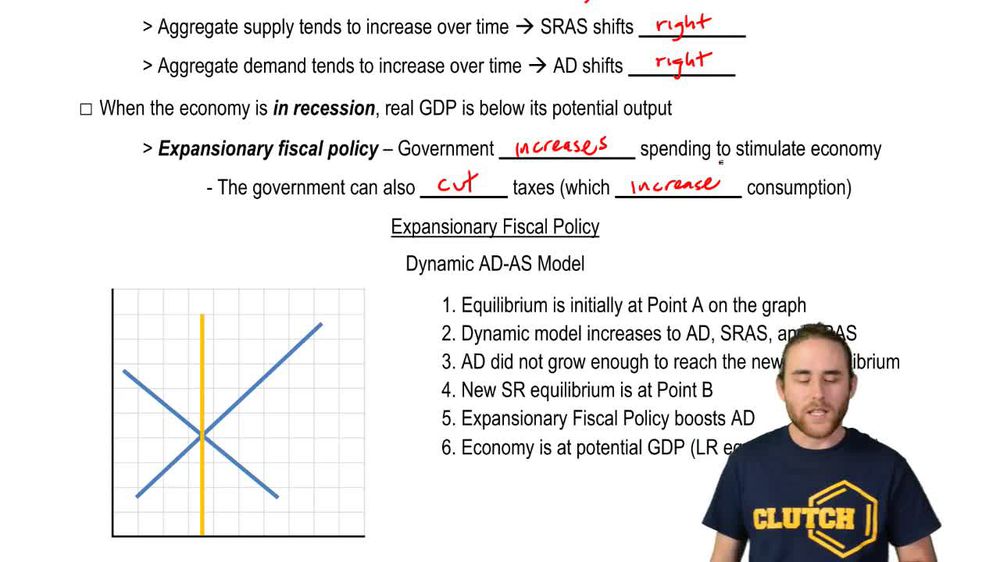
Expansionary fiscal policy increases aggregate demand by raising government spending or cutting taxes.
When is expansionary fiscal policy typically used in the dynamic AD-AS model?
It is used during a recession when real GDP is below potential GDP.
What are two main tools of expansionary fiscal policy?
The two main tools are increasing government spending and cutting taxes.
What happens to the aggregate demand curve when the government implements expansionary fiscal policy?
The aggregate demand curve shifts to the right.
What is the effect of contractionary fiscal policy on aggregate demand?
Contractionary fiscal policy decreases aggregate demand by reducing government spending or increasing taxes.
When is contractionary fiscal policy typically used?
It is used when the economy is experiencing inflation and real GDP is above potential GDP.
How does increasing taxes affect aggregate demand?
Increasing taxes lowers consumption, which decreases aggregate demand.
What is the purpose of contractionary fiscal policy in the dynamic AD-AS model?
Its purpose is to reduce inflation by bringing aggregate demand back in line with potential GDP.
In the dynamic AD-AS model, what generally happens to long-run aggregate supply over time?
Long-run aggregate supply tends to shift to the right year over year as the economy grows.
What does it mean for the economy to be at long-run equilibrium in the dynamic AD-AS model?
It means that aggregate demand, short-run aggregate supply, and long-run aggregate supply all intersect at the same point, representing potential GDP.
What happens if aggregate demand increases too much in the dynamic AD-AS model?
If aggregate demand increases too much, the economy exceeds potential GDP, leading to inflation.
How does the government use fiscal policy to address a shortfall in aggregate demand?
The government increases spending or cuts taxes to boost aggregate demand and reach potential GDP.
What is the effect of decreasing government spending in contractionary fiscal policy?
Decreasing government spending lowers aggregate demand, helping to reduce inflation.
Why is understanding fiscal policy in the dynamic AD-AS model important for macroeconomics?
It highlights the role of government intervention in managing economic cycles, aggregate supply, and demand to maintain market equilibrium.
 BackBack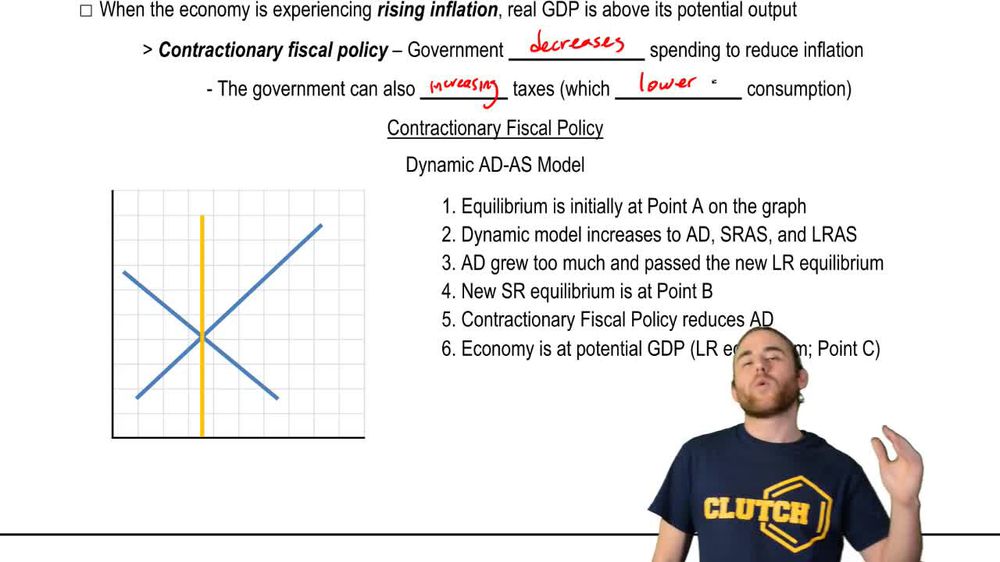
 03:59
03:59