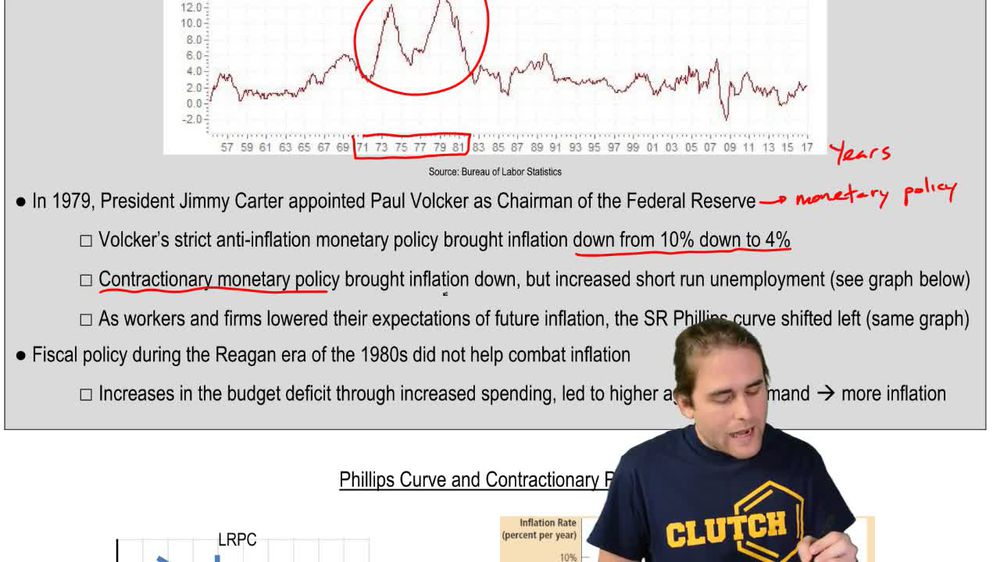
Disinflation is a reduction in the inflation rate while still maintaining a positive inflation rate. Prices continue to rise, but at a slower pace than before.
What is deflation?
Deflation is a negative inflation rate, meaning the overall price level declines. Prices are lower than the previous year.
How does disinflation differ from deflation?
Disinflation means inflation is still positive but decreasing, while deflation means inflation is negative and prices are falling.
Who was the Federal Reserve Chairman responsible for disinflation in the late 1970s and early 1980s?
Paul Volcker was the Federal Reserve Chairman who implemented contractionary monetary policy to reduce inflation during that period.
What monetary policy did Paul Volcker use to achieve disinflation?
He used strict contractionary monetary policy, reducing the money supply and increasing interest rates to lower inflation.
What was the effect of Volcker’s contractionary monetary policy on unemployment in the short run?
It increased short-run unemployment due to the Phillips curve trade-off between inflation and unemployment.
What does the Phillips curve illustrate in the context of disinflation?
The Phillips curve shows an inverse relationship between inflation and unemployment; as inflation decreases, unemployment increases in the short run.
What happens to inflation expectations in the long run after disinflation?
Workers and firms lower their expectations of future inflation, which shifts the short-run Phillips curve to the left.
What is the natural rate of unemployment?
The natural rate of unemployment is the long-run equilibrium level of unemployment, typically around 5% in the U.S.
How did fiscal policy during the Reagan era affect inflation?
Fiscal policy increased the budget deficit and aggregate demand, contributing to higher inflation during the Reagan era.
How can you identify deflation using the inflation rate?
Deflation is identified by a negative inflation rate, indicating that the price level is decreasing.
What happens to the price level during disinflation?
The price level continues to increase, but at a slower rate each year.
What happens to the price level during deflation?
The price level decreases, meaning goods and services become cheaper over time.
Why is it important not to confuse disinflation with deflation?
Because disinflation still involves rising prices at a slower rate, while deflation means prices are actually falling.
What is a common test trick regarding disinflation and deflation?
Questions often ask you to distinguish between disinflation (slower price increases) and deflation (falling prices), so remembering the difference can earn easy points.
 Back
Back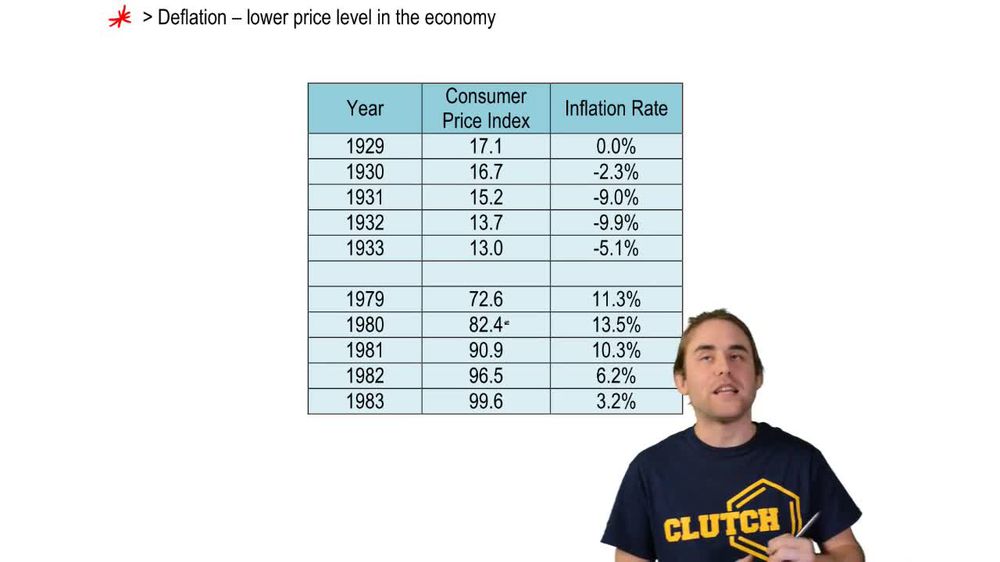
 02:29
02:29