Skip to main content
Microeconomics
My Course
Learn
Exam Prep
AI Tutor
Study Guides
Flashcards
Explore
Try the app
My Course
Learn
Exam Prep
AI Tutor
Study Guides
Flashcards
Explore
Try the app
Back
Deriving the Multiplier Algebraically quiz
You can tap to flip the card.
What does the multiplier effect in macroeconomics describe?
You can tap to flip the card.
👆
What does the multiplier effect in macroeconomics describe?
It describes how an initial increase in autonomous consumption or investment leads to a multiplied increase in GDP.
Track progress
Control buttons has been changed to "navigation" mode.
1/15
Related flashcards
Recommended videos
Deriving the Multiplier Algebraically definitions
Deriving the Multiplier Algebraically
14 Terms
Guided course
07:15
Deriving the Multiplier Algebraically
Terms in this set (15)
Hide definitions
What does the multiplier effect in macroeconomics describe?
It describes how an initial increase in autonomous consumption or investment leads to a multiplied increase in GDP.
In a private closed economy, what components make up aggregate expenditures (AE)?
Aggregate expenditures are made up of consumption (C) and investment (I).
How is the consumption function typically expressed in the multiplier model?
It is expressed as autonomous consumption plus the marginal propensity to consume (MPC) times income (Y), or C = A + MPC × Y.
At equilibrium in the aggregate expenditures model, what is the relationship between AE and GDP?
At equilibrium, aggregate expenditures (AE) equal GDP (Y).
How do you rearrange the equilibrium equation Y = A + MPC × Y + I to solve for Y?
You move MPC × Y to the left side, factor out Y, and solve to get Y = (A + I) / (1 - MPC).
What is the formula for the multiplier in terms of MPC?
The multiplier is 1 divided by (1 minus MPC), or 1/(1 - MPC).
What does the multiplier tell us about changes in investment or autonomous consumption?
It tells us that any change in investment or autonomous consumption will result in a multiplied change in equilibrium GDP.
Why is all income considered disposable in the private closed economy model used here?
Because there are no taxes or government transfers in this simplified model.
What happens to GDP if there is an increase in investment according to the multiplier model?
GDP increases by the amount of the investment times the multiplier.
How does the marginal propensity to consume (MPC) affect the size of the multiplier?
A higher MPC increases the size of the multiplier, while a lower MPC decreases it.
What is autonomous consumption?
Autonomous consumption is the level of consumption that occurs even if income is zero.
Why is the multiplier effect important during a recession?
Because increasing investment spending can have a multiplied effect on boosting GDP.
What algebraic step allows you to factor Y out of Y - MPC × Y?
You factor Y to get Y × (1 - MPC).
If MPC is 0.8, what is the value of the multiplier?
The multiplier is 1/(1 - 0.8) = 5.
What does the equation Y = (A + I) / (1 - MPC) show about the relationship between spending and GDP?
It shows that equilibrium GDP is a multiple of the sum of autonomous consumption and investment, determined by the multiplier.
 BackBack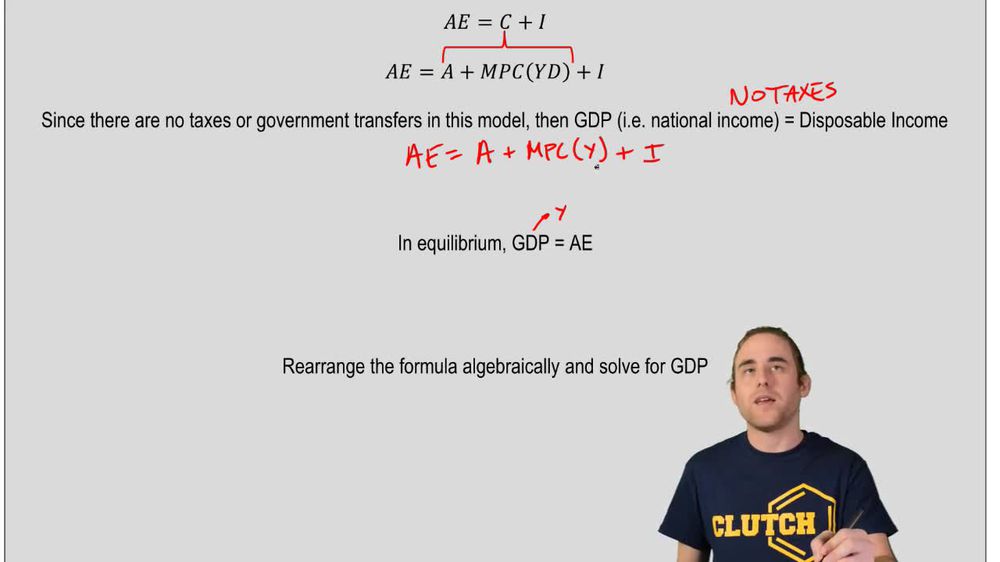
 07:15
07:15