Skip to main content
Microeconomics
My Course
Learn
Exam Prep
AI Tutor
Study Guides
Flashcards
Explore
Try the app
My Course
Learn
Exam Prep
AI Tutor
Study Guides
Flashcards
Explore
Try the app
Back
Deriving the Multiplier Algebraically definitions
You can tap to flip the card.
Multiplier
You can tap to flip the card.
👆
Multiplier
A factor showing how an initial change in spending leads to a larger change in GDP, calculated as one over one minus marginal propensity to consume.
Track progress
Control buttons has been changed to "navigation" mode.
1/14
Related flashcards
Recommended videos
Deriving the Multiplier Algebraically quiz
Deriving the Multiplier Algebraically
15 Terms
Guided course
07:15
Deriving the Multiplier Algebraically
Terms in this set (14)
Hide definitions
Multiplier
A factor showing how an initial change in spending leads to a larger change in GDP, calculated as one over one minus marginal propensity to consume.
Marginal Propensity to Consume
The proportion of additional income that is spent on consumption, influencing the size of the multiplier in the economy.
Autonomous Consumption
Spending on goods and services that occurs even when income is zero, reflecting basic needs like food and shelter.
Aggregate Expenditures
The total amount spent in an economy, represented as the sum of consumption and investment in a private closed model.
Private Closed Economy
An economic model excluding government and international trade, focusing only on households and businesses.
Consumption Function
An equation expressing total consumption as the sum of autonomous consumption and marginal propensity to consume times income.
Investment
Spending by businesses on capital goods, which contributes to aggregate expenditures and influences GDP through the multiplier.
Equilibrium GDP
The level of output where aggregate expenditures equal total income, ensuring no unintended inventory changes.
Disposable Income
Income available to households after taxes, used for consumption and saving in simplified models without government.
Algebraic Derivation
The process of rearranging and factoring equations to isolate variables and reveal relationships, such as the multiplier formula.
GDP
The total value of goods and services produced in an economy, used as a measure of economic output and equilibrium.
Equilibrium
A state where aggregate expenditures match total output, resulting in stable economic conditions without excess supply or demand.
Multiplier Effect
The phenomenon where an increase in spending causes a greater overall increase in economic output due to repeated rounds of consumption.
Aggregate Demand
The total demand for goods and services in an economy, influenced by changes in consumption, investment, and the multiplier.
 BackBack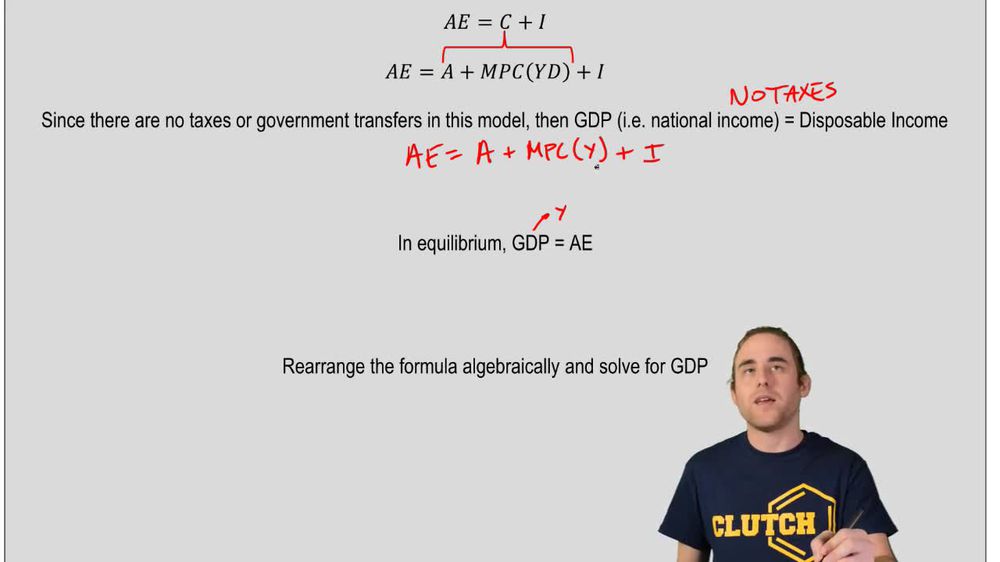
 07:15
07:15