What are shoe leather costs in the context of inflation?
Shoe leather costs are resources wasted as people try to avoid holding cash during inflation, such as making frequent trips to the bank.
Why is holding cash considered bad during periods of inflation?
Holding cash is bad during inflation because rising prices decrease the value of cash, reducing its purchasing power.
What imagery is used to describe shoe leather costs and why?
The imagery is of wearing out your shoes from frequent trips to the bank, representing the inconvenience and time spent avoiding holding cash.
How does hyperinflation affect shoe leather costs?
Hyperinflation greatly increases shoe leather costs because people must avoid holding rapidly devaluing cash, leading to more frequent bank visits.
What is the typical threshold for an inflation rate to be considered hyperinflation?
Hyperinflation is generally defined as an inflation rate above 50%.
Give an example of a country that has experienced hyperinflation.
Post World War I Germany and Zimbabwe are examples of countries that have experienced hyperinflation.
What are menu costs in relation to inflation?
Menu costs are the expenses businesses face when they have to frequently change prices, such as printing new menus or price tags.
Why do restaurants sometimes put stickers over menu prices during inflation?
Restaurants use stickers to avoid the higher menu costs of printing entirely new menus when prices change frequently.
How does the frequency of price changes impact menu costs?
The more often prices change, the higher the menu costs, as businesses must update prices more frequently.
What happens to menu costs during periods of hyperinflation?
Menu costs become very high during hyperinflation because businesses must constantly retag or reprint prices.
What is meant by 'tax costs' as a result of inflation?
Tax costs occur when inflation creates phantom income, causing people to pay taxes on nominal gains that do not reflect real increases in purchasing power.
How can inflation lead to taxes on phantom income?
If an asset's price rises due to inflation, the owner may be taxed on the nominal gain, even though their real purchasing power hasn't increased.
Why might someone not actually gain in real terms even if their asset's price increases during inflation?
Because the price increase may only reflect inflation, not an actual increase in the asset's real value or purchasing power.
How do inflation-induced costs impact market efficiency?
Inflation-induced costs like shoe leather, menu, and tax costs create economic distortions that reduce market efficiency.
Why is it important for economists to anticipate inflation?
Anticipating inflation is important because it helps understand and mitigate the economic distortions and costs inflation causes.
 Back
Back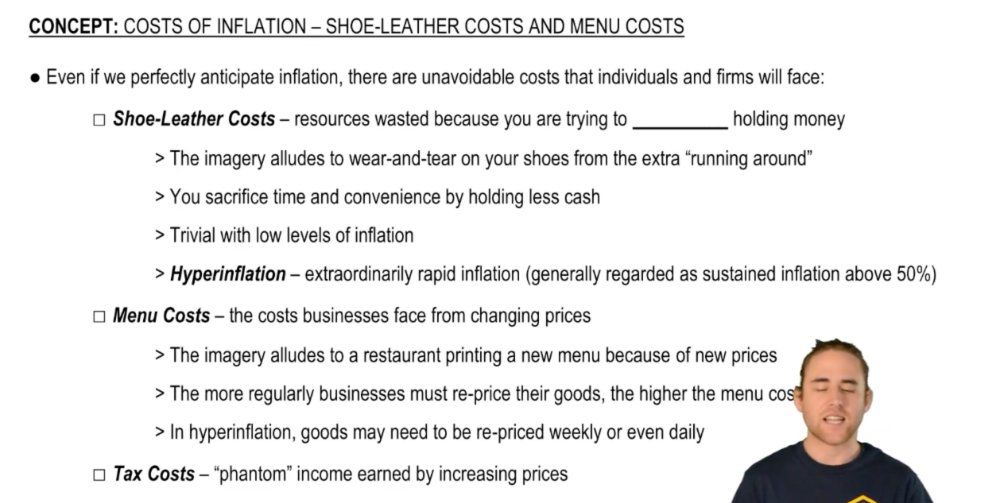
 04:37
04:37