Back

Consumer Optimum Consumption: Marginal Utility per Dollar Spent quiz

Control buttons has been changed to "navigation" mode.
1/15
  • What is the condition for a consumer's optimum consumption when considering marginal utility per dollar spent?

    Optimum consumption occurs when the marginal utility per dollar spent is equal for all goods, given the consumer's budget constraint.
  • Why do we calculate marginal utility per dollar instead of just marginal utility?

    Because different goods have different prices, calculating marginal utility per dollar allows us to compare the utility gained from spending on each good.
  • What principle is demonstrated when marginal utility decreases as more of a good is consumed?

    This demonstrates the principle of diminishing returns, where each additional unit provides less satisfaction.
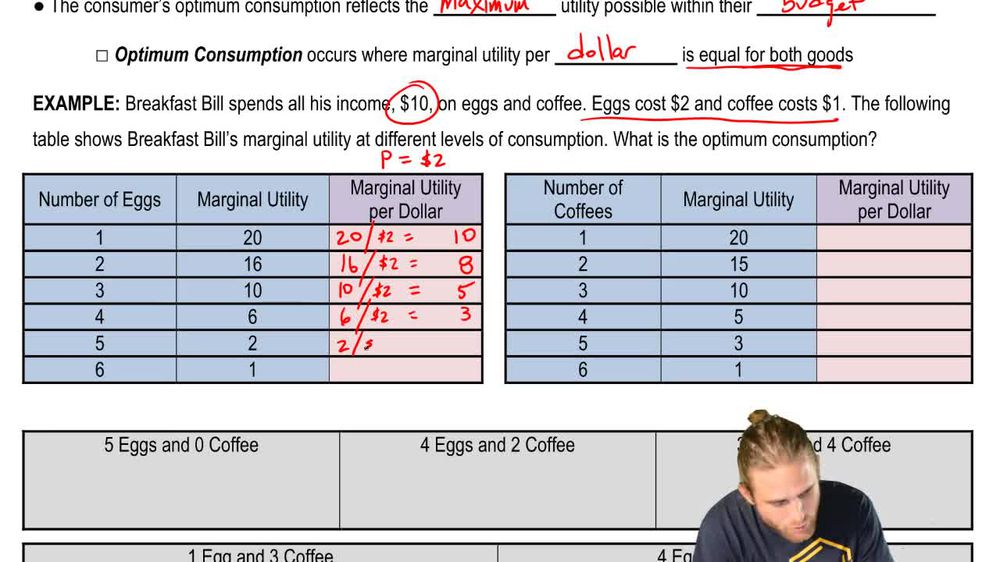
  • If eggs cost \$2 each and the marginal utility of the first egg is 20, what is the marginal utility per dollar for the first egg?

    The marginal utility per dollar is 10 (20 divided by 2).
  • How do you calculate the marginal utility per dollar for coffee if coffee costs \$1 and the marginal utility is 15?

    Divide the marginal utility by the price: 15 divided by 1 equals 15.
  • What is the total utility if Breakfast Bill buys 5 eggs and 0 coffee, given the marginal utilities for eggs are 20, 16, 10, 6, and 2?

    The total utility is 54 (20 + 16 + 10 + 6 + 2).
  • Why might reallocating spending from eggs to coffee increase total utility?

    Because spending more on the good with higher marginal utility per dollar increases overall satisfaction, maximizing total utility.
  • What is the optimum consumption bundle for Breakfast Bill if he has \$10, eggs cost \$2, coffee costs \$1, and marginal utility per dollar is equal at 3 eggs and 4 coffees?

    The optimum bundle is 3 eggs and 4 coffees, as this combination equalizes marginal utility per dollar and uses the entire \$10 budget.
  • How do you determine if a consumption bundle is affordable for a consumer?

    Multiply the quantity of each good by its price and ensure the total does not exceed the consumer's budget.
  • What is the total utility for a bundle of 4 eggs and 2 coffees, given marginal utilities for eggs are 20, 16, 10, 6 and for coffee are 20, 15?

    The total utility is 87 (20 + 16 + 10 + 6 + 20 + 15).
  • If the marginal utility per dollar for eggs is 5 and for coffee is also 5, what does this indicate about the consumption bundle?

    It indicates that the consumer is at an optimum consumption point for their budget.
  • What happens to total utility if a consumer chooses a bundle where marginal utility per dollar is not equal for all goods?

    Total utility will not be maximized; reallocating spending can increase utility until marginal utility per dollar is equalized.
  • How do you find the marginal utility per dollar for the second egg if its marginal utility is 16 and the price is \$2?

    Divide 16 by 2, resulting in a marginal utility per dollar of 8.
  • What is the optimum consumption bundle if a consumer has \$5, eggs cost \$2, coffee costs \$1, and marginal utility per dollar is equal at 1 egg and 3 coffees?

    The optimum bundle is 1 egg and 3 coffees, as this uses the \$5 budget and equalizes marginal utility per dollar.
  • Why is it important to check if the optimum bundle is purchasable within the consumer's budget?

    Because the consumer cannot spend more than their budget, so only affordable bundles can be considered for optimum consumption.