Skip to main content
Microeconomics
My Course
Learn
Exam Prep
AI Tutor
Study Guides
Flashcards
Explore
Try the app
My Course
Learn
Exam Prep
AI Tutor
Study Guides
Flashcards
Explore
Try the app
Back
Classical Model and Keynesian Model definitions
You can tap to flip the card.
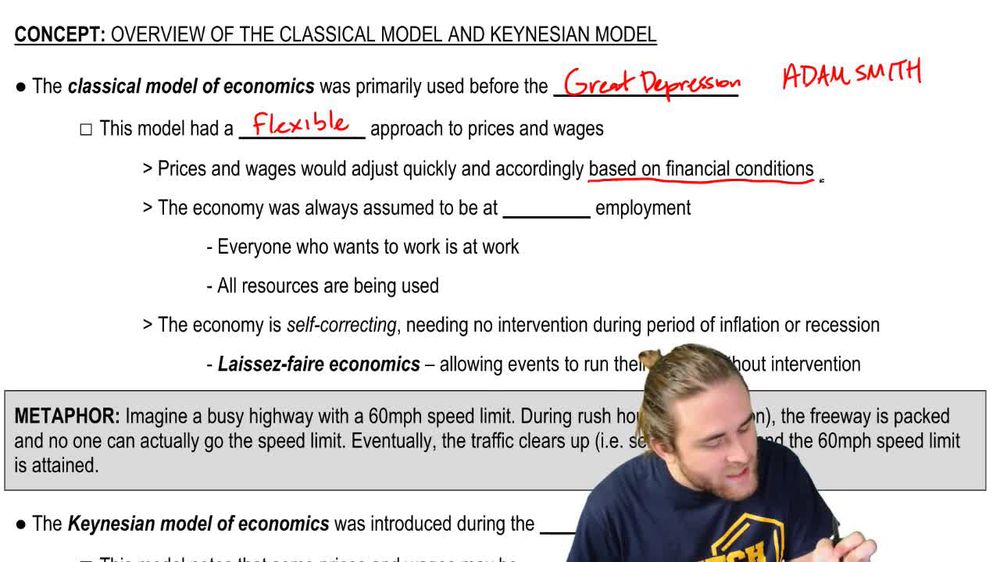
Classical Model
You can tap to flip the card.
👆
Classical Model
Economic framework assuming flexible prices and wages, full employment, and self-correcting markets without government intervention.
Track progress
Control buttons has been changed to "navigation" mode.
1/15
Related flashcards
Recommended videos
Classical Model and Keynesian Model quiz
Classical Model and Keynesian Model
15 Terms
Guided course
03:04
Keynesian Model
Guided course
02:54
Classical Model
Guided course
03:41
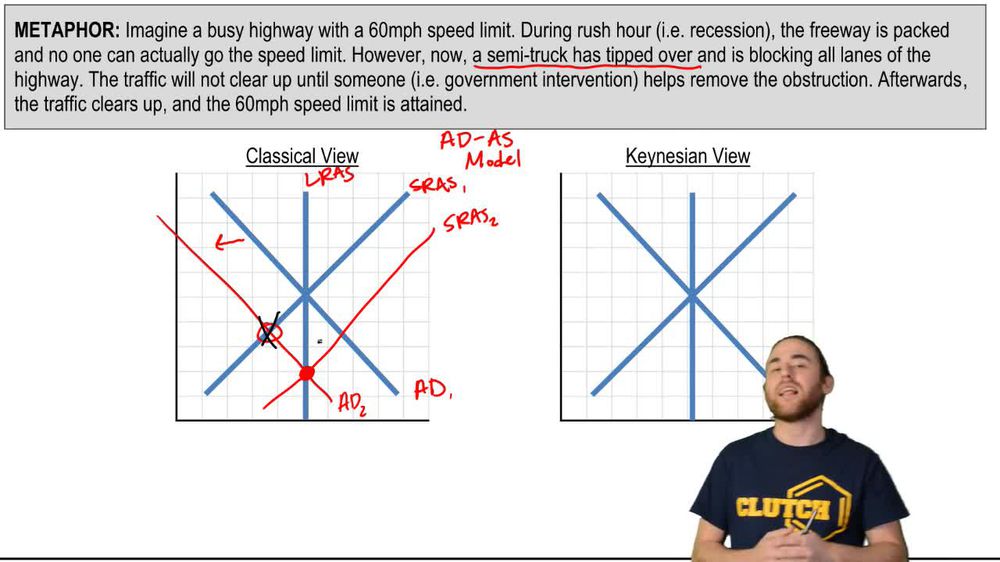
Graphical Comparison of Classical Model and Keynesian Model
Terms in this set (15)
Hide definitions
Classical Model
Economic framework assuming flexible prices and wages, full employment, and self-correcting markets without government intervention.
Keynesian Model
Economic theory emphasizing sticky prices and wages, unemployment, and the necessity of government intervention during recessions and inflation.
Flexible Prices
Market condition where prices adjust quickly in response to changes in supply and demand, enabling rapid equilibrium restoration.
Sticky Wages
Situation where wage levels remain unchanged despite shifts in economic conditions, often due to contracts or institutional factors.
Full Employment
State where all available labor resources are being used efficiently, and anyone seeking work can find a job.
Self-Correcting Market
Economic system that naturally returns to equilibrium without external intervention, relying on internal adjustments.
Laissez-Faire
Principle advocating minimal government involvement in economic affairs, allowing markets to operate freely.
Government Intervention
Actions by authorities to influence economic outcomes, such as addressing recessions or inflation through policy measures.
Aggregate Demand
Total spending on goods and services within an economy, represented as a downward-sloping curve in macroeconomic models.
Aggregate Supply
Total output of goods and services produced by an economy, depicted as both short-run and long-run curves in models.
Short Run Equilibrium
Temporary state where aggregate demand and aggregate supply intersect, not necessarily at potential GDP.
Long Run Equilibrium
Condition where aggregate demand, short-run aggregate supply, and long-run aggregate supply meet at potential GDP.
Potential GDP
Maximum sustainable output an economy can produce when all resources are fully employed.
Recession
Period of economic decline marked by reduced aggregate demand, increased unemployment, and lower output.
Invisible Hand
Metaphor for the self-regulating nature of markets, guiding resources to their most efficient uses without direct intervention.
 BackBack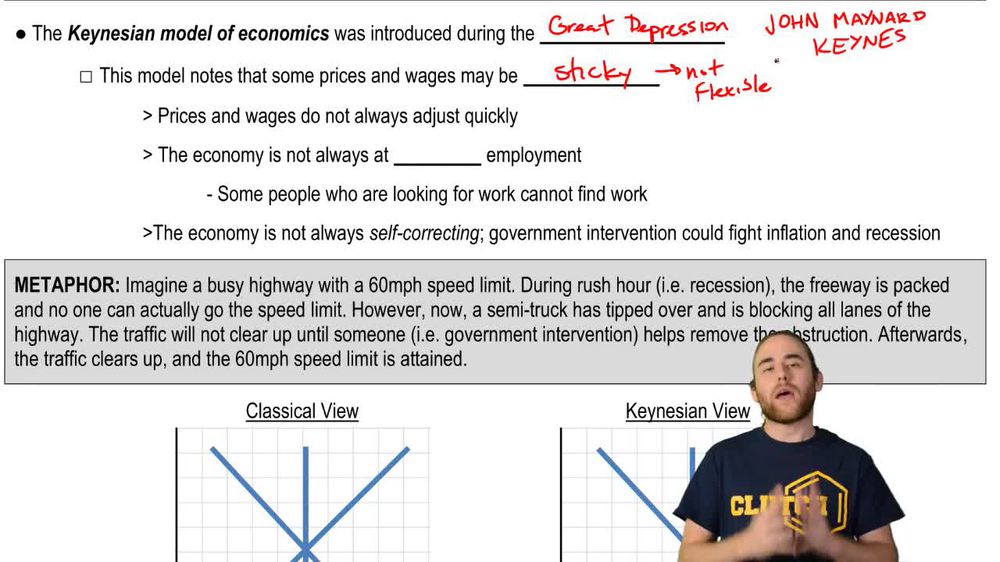
 03:04
03:04