Skip to main content
Microeconomics
My Course
Learn
Exam Prep
AI Tutor
Study Guides
Flashcards
Explore
Try the app
My Course
Learn
Exam Prep
AI Tutor
Study Guides
Flashcards
Explore
Try the app
Back
Aggregate Expenditures Model and Macroeconomic Equilibrium quiz
You can tap to flip the card.
What does the term 'aggregate expenditures' (AE) represent in macroeconomics?
You can tap to flip the card.
👆
What does the term 'aggregate expenditures' (AE) represent in macroeconomics?
Aggregate expenditures represent the total spending in an economy during a specific period.
Track progress
Control buttons has been changed to "navigation" mode.
1/15
Related flashcards
Recommended videos
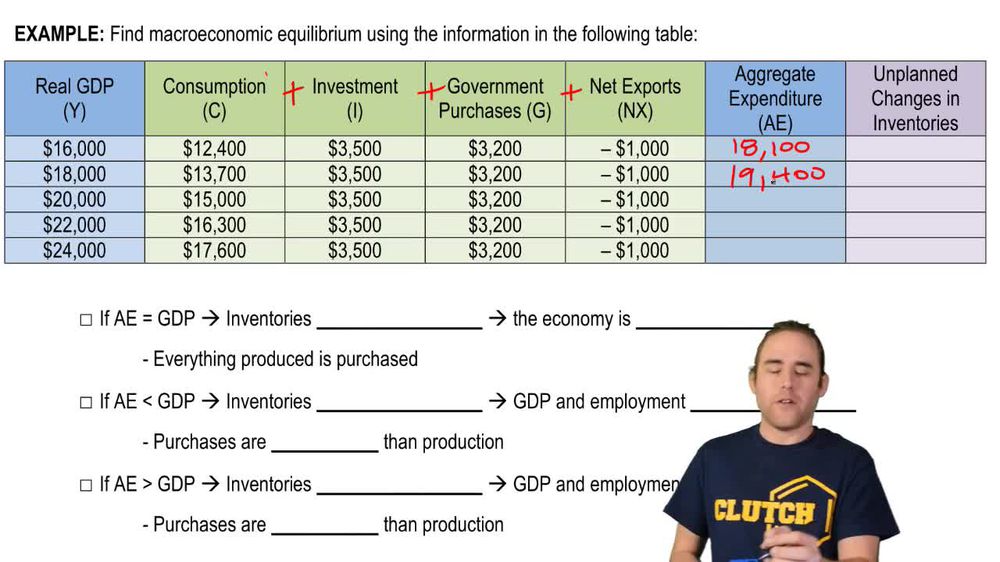
Aggregate Expenditures Model and Macroeconomic Equilibrium definitions
Aggregate Expenditures Model and Macroeconomic Equilibrium
13 Terms
Guided course
07:08
Aggregate Expenditures Model and Macroeconomic Equilibrium
Guided course
10:19
Numerical Aggregate Expenditures
1
views
Terms in this set (15)
Hide definitions
What does the term 'aggregate expenditures' (AE) represent in macroeconomics?
Aggregate expenditures represent the total spending in an economy during a specific period.
What is the formula for aggregate expenditures (AE) in the AE model?
AE = Consumption + Investment + Government Purchases + Net Exports.
In the aggregate expenditures model, what key assumption is made about prices?
The model assumes that prices are sticky, meaning they are fixed and do not change.
When does macroeconomic equilibrium occur in the AE model?
Equilibrium occurs when aggregate expenditures equal real GDP.
How is real GDP defined in the context of the AE model?
Real GDP is the value of production in the economy with prices held constant.
What is the marginal propensity to consume (MPC)?
The MPC is the fraction of each additional dollar of income that is spent on consumption.
How does consumption change as disposable income increases, according to the AE model?
Consumption increases linearly as disposable income increases.
Which components of aggregate expenditures are treated as constants in the AE model?
Investment, government purchases, and net exports are treated as constants.
How does the AE model relate spending and production in the economy?
The model links total spending (AE) to the level of production (real GDP), assuming production must keep up with spending.
What happens to consumption if the marginal propensity to consume is 0.8 and income increases by \$1?
Consumption increases by \$0.80, and the remaining \$0.20 is saved.
What is the main difference between aggregate expenditures and GDP in the AE model?
There is no difference at equilibrium; AE equals GDP when the economy is in equilibrium.
What is the multiplier effect in the context of the AE model?
The multiplier effect refers to the amplified impact that a change in investment or government spending has on overall economic output.
Why is consumption shown as an upward-sloping line in the AE model?
Because as disposable income increases, consumption also increases, reflecting a positive relationship.
If government purchases increase, what effect does the AE model predict on GDP?
An increase in government purchases will increase GDP, amplified by the multiplier effect.
Why do we use real GDP instead of nominal GDP in the AE model?
We use real GDP to keep prices constant and focus on changes in production and spending, not price changes.
 BackBack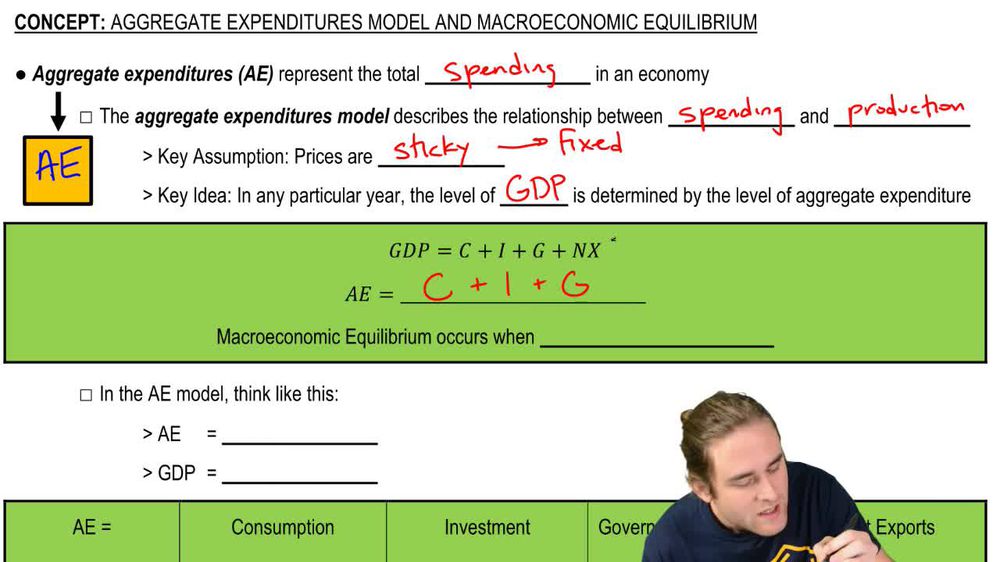
 07:08
07:08