Skip to main content
Microeconomics
My Course
Learn
Exam Prep
AI Tutor
Study Guides
Flashcards
Explore
Try the app
My Course
Learn
Exam Prep
AI Tutor
Study Guides
Flashcards
Explore
Try the app
Back
Aggregate Expenditures Model and Macroeconomic Equilibrium definitions
You can tap to flip the card.
Aggregate Expenditures
You can tap to flip the card.
👆
Aggregate Expenditures
Total spending in an economy, including consumption, investment, government purchases, and net exports.
Track progress
Control buttons has been changed to "navigation" mode.
1/13
Related flashcards
Recommended videos
Aggregate Expenditures Model and Macroeconomic Equilibrium quiz
Aggregate Expenditures Model and Macroeconomic Equilibrium
15 Terms
Guided course
07:08
Aggregate Expenditures Model and Macroeconomic Equilibrium
Guided course
10:19
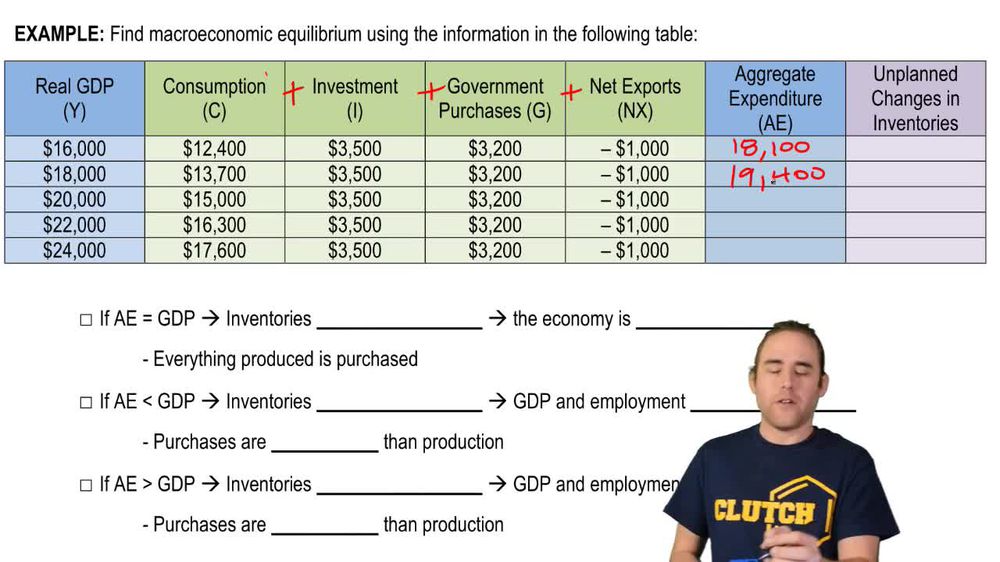
Numerical Aggregate Expenditures
1
views
Terms in this set (13)
Hide definitions
Aggregate Expenditures
Total spending in an economy, including consumption, investment, government purchases, and net exports.
AE Model
Framework linking total spending to production, assuming fixed prices and focusing on real GDP.
Sticky Prices
Situation where prices remain unchanged, allowing analysis without price fluctuations.
Real GDP
Measure of production that keeps prices constant, reflecting actual output.
Equilibrium
Point where total spending matches production, ensuring no unintended inventory changes.
Consumption
Spending by households, influenced by disposable income and marginal propensity to consume.
Investment
Constant component of total spending, representing business expenditures on capital.
Government Purchases
Constant spending by the public sector, contributing to total expenditures.
Net Exports
Constant value representing exports minus imports in total spending.
Disposable Income
Income available to households after taxes, determining consumption levels.
Marginal Propensity to Consume
Fraction of additional income spent by households, shaping the slope of the consumption function.
Consumption Function
Linear relationship showing how household spending increases with disposable income.
Multiplier Effect
Process where changes in investment or government spending amplify overall economic output.
 BackBack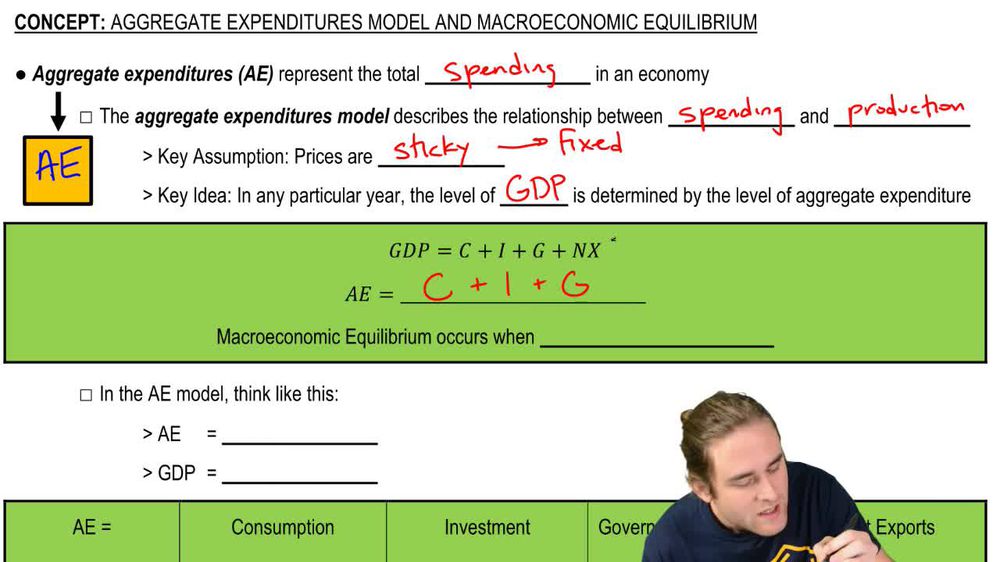
 07:08
07:08