What does the aggregate demand curve represent in an economy?
It represents the total demand for goods and services in an economy, showing the relationship between the Consumer Price Index (CPI) and real GDP.
What is plotted on the y-axis of the aggregate demand curve?
The y-axis is labeled with the Consumer Price Index (CPI), which measures the overall price level in the economy.
Why is real GDP used on the x-axis instead of nominal GDP in the aggregate demand curve?
Real GDP is used because it is inflation-adjusted and avoids including price levels on both axes, unlike nominal GDP.
What does the term 'aggregate' mean in the context of aggregate demand?
Aggregate means to add together, so aggregate demand is the sum of demand for all products in the economy.
Why does the aggregate demand curve slope downward?
It slopes downward due to the wealth effect, interest rate effect, and foreign price effect, each showing how higher prices reduce real GDP.
What is the wealth effect in relation to aggregate demand?
The wealth effect states that higher prices reduce consumers' purchasing power, leading to lower consumption and real GDP.
How does an increase in the Consumer Price Index (CPI) affect consumers according to the wealth effect?
An increase in CPI lowers consumers' purchasing power, so they can buy less with the same amount of money.
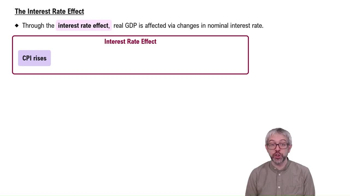
What is the interest rate effect in the context of aggregate demand?
The interest rate effect argues that rising prices lead banks to increase nominal interest rates, which reduces borrowing and investment, lowering real GDP.
How do banks respond when their real interest income decreases due to rising prices?
Banks increase nominal interest rates to compensate for the loss in real interest income caused by higher prices.
What happens to borrowing and investment when nominal interest rates rise?
Borrowing falls because loans become more expensive, which leads to lower investment and consumption, decreasing real GDP.
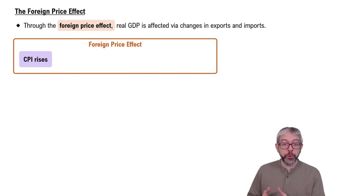
What is the foreign price effect in aggregate demand?
The foreign price effect states that when domestic prices rise, exports decrease and imports increase, lowering net exports and real GDP.
How do rising domestic prices affect exports and imports according to the foreign price effect?
Rising domestic prices make exports less attractive and imports more attractive, causing exports to fall and imports to rise.
Which component of GDP is directly affected by the foreign price effect?
Net exports are directly affected, as exports decrease and imports increase, both lowering net exports.
When prices rise, which components of GDP decrease according to the three effects discussed?
Consumption, investment, and net exports decrease, while government spending remains unchanged.
What are the three main reasons for the downward slope of the aggregate demand curve?
The three reasons are the wealth effect, the interest rate effect, and the foreign price effect.
 Back
Back
 02:47
02:47